

Is low acid coffee easier on your stomach?
Low acid coffee is not reliably easier on your stomach: a less acidic brew does not guarantee less heartburn, nausea, or digestive discomfort. Caffeine, serving size, other ingredients, and your own triggers still matter. Choose by the symptom you want to reduce, not by a low acid label alone.
- Is low acid coffee easier on your stomach? Not reliably; lower acidity does not guarantee fewer digestive symptoms.
- For acid reflux, consider serving size, caffeine, timing, and personal triggers—not just roast or brewing method.
- Cinder and Cedar Coffee Roasters offers roast and flavor choices; those descriptions do not establish stomach tolerance.
- Change one part of your coffee routine at a time, and stop if symptoms return.
Why this matters
A coffee that tastes smooth can still leave you uncomfortable. Sour flavor, the acidity measured in a cup, and acid reflux are different things, so treating them as interchangeable leads to the wrong purchase.
For your 2026 coffee routine, start by identifying what happens after you drink coffee. Burning behind your breastbone calls for a different conversation than loose stools or discomfort after adding cream. Before comparing low acid coffee beans, decide which problem you are actually trying to solve.
Is low acid coffee easier on your stomach?
Low acid coffee is a brewing or product characteristic, not a guarantee of digestive comfort. Some people tolerate a particular coffee better than another, but the label alone does not explain why. A smaller serving, less caffeine, or a change in milk can also account for the difference.
The American College of Gastroenterology's 2022 guideline on gastroesophageal reflux disease recommends avoiding personal trigger foods for symptom control. It does not establish low acid coffee as a treatment for reflux. That distinction matters when a package promises a smooth cup without providing evidence about digestive symptoms.
Use this comparison to choose a relevant change, rather than assuming every alternative solves the same problem.
| Coffee choice | Best for | Useful feature | Limitation |
|---|---|---|---|
| Coffee labeled low acid | Comparing products with documented acidity information | Gives you an acidity claim to examine | Does not establish that you will have fewer symptoms |
| Decaf coffee | Reducing caffeine while keeping a coffee routine | Contains less caffeine than regular coffee | Still contains some caffeine and can still trigger symptoms |
| Dark roast coffee | Drinkers who prefer deeper roast flavors | Offers a different flavor profile | Roast level does not prove stomach tolerance |
| Cold brew coffee | Drinkers who prefer cold preparation and its flavor | Changes the brewing method | Concentration and serving size still matter |
| A smaller serving of your usual coffee | Checking whether quantity affects comfort | Keeps the coffee itself unchanged | Does not identify every possible trigger |
The practical 2026 buying rule is simple: choose a change that matches your concern, and judge it by your symptoms. A coffee preference is useful; a medical promise requires different evidence.
What does “low acid” actually tell you?
Acidity can describe either taste or chemistry. In tasting notes, bright acidity means a lively, sometimes fruit-like impression. It is not a direct measurement of how a coffee will affect your stomach.
Measured acidity also needs context. A pH reading and a measurement of total acids describe different properties, and results depend on how the coffee was prepared. Comparing claims without knowing the brewing recipe can leave you comparing unlike drinks.
Before choosing a coffee because of an acidity claim, look for:
- A stated measurement: Does the description discuss measured acidity or simply a smooth taste?
- A clear comparison: Lower than which coffee, prepared in what way?
- A relevant outcome: Is the evidence about the liquid, or about symptoms in people?
- A defined serving: Does the comparison concern ready-to-drink coffee or concentrate?
A useful 2026 label-reading habit is to separate flavor language from health language. “Smooth,” “mellow,” and “low bitterness” describe the drinking experience; they do not establish that a product prevents heartburn.
Why your response to coffee varies
The same coffee can fit one person's routine and bother another. These factors are more useful to examine than treating acidity as the only explanation.
- Caffeine: Reducing caffeine is a distinct change from reducing acidity. Decaf lets you examine that difference without giving up coffee's flavor entirely.
- Serving size: A small cup and a large mug are different exposures. Record the amount you actually drink, including refills.
- Brew strength: Diluted cold brew and undiluted concentrate are not interchangeable. Follow the preparation directions before assessing comfort.
- Added ingredients: Milk, cream, sweeteners, chocolate, or mint introduce other possible triggers. Lactose can cause digestive symptoms in people with lactose intolerance.
- Timing and lying down: Drinking coffee close to bedtime can overlap with a reflux-provoking routine. Meal timing also matters when reflux is the concern.
- Your underlying symptoms: Reflux, nausea, and bowel urgency are not the same condition. Persistent symptoms need assessment rather than repeated coffee substitutions.
You do not need to eliminate everything at once. Keeping the rest of your routine steady makes a single change easier to interpret, although a home comparison cannot diagnose a medical condition.
How can you check whether a different coffee helps?
Use a simple comparison only for mild, occasional symptoms. Do not deliberately bring back symptoms that are severe, and do not change prescribed treatment to test a coffee.
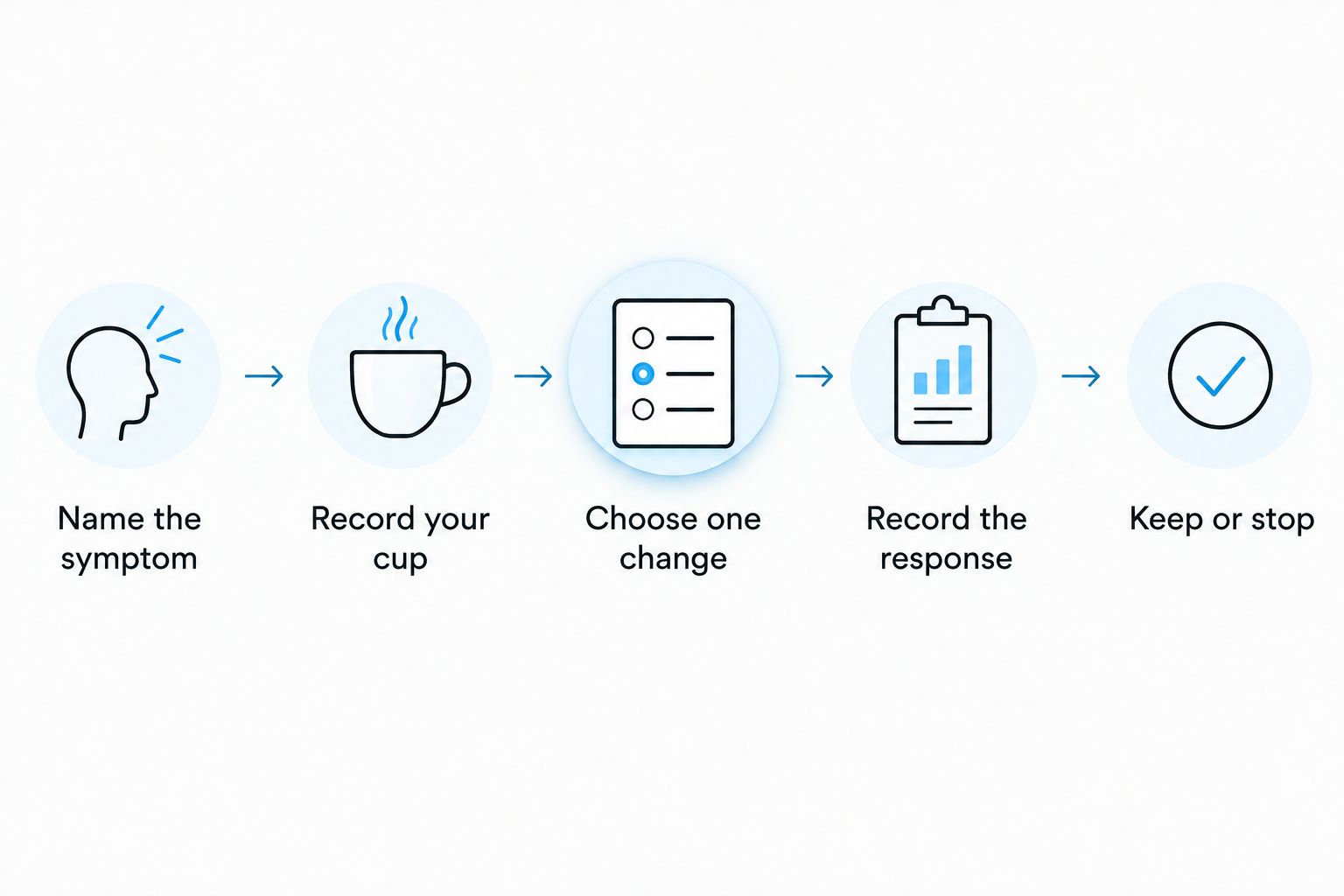
- Name the symptom. Write down whether you notice burning, sour fluid coming up, nausea, bloating, or bowel urgency. Avoid recording everything as a sensitive stomach.
- Record your usual cup. Note the coffee, brewing method, serving size, additions, and when you drink it. Use a measuring cup rather than guessing from the mug's appearance.
- Choose one change. Try a smaller serving if quantity is your question, or decaf if caffeine is your question. Keep the other details unchanged where practical.
- Record the response. Note whether symptoms occur and what else happened around that drink, including meals and lying down. Do not turn one comfortable cup into a guaranteed result.
- Keep or stop. Keep a change that suits you, but stop drinking the coffee if symptoms return. Seek medical advice for recurring discomfort.
As a practical example, compare a measured 4 fl oz serving with your usual 8 fl oz serving while keeping the coffee and additions the same. These are example portions for a comparison, not medically established safe amounts. There is no universal cup size that guarantees comfort.
For a useful 2026 record, write down the full drink rather than just the bean name. A refill, a stronger recipe, or a different creamer changes what you are comparing.
Is decaf better than low acid coffee for reflux?
Decaf is the more direct choice when your goal is to reduce caffeine. Low acid coffee and decaf address different characteristics, so neither label substitutes for the other.
Decaf still contains some caffeine, and switching does not guarantee relief from reflux. If regular coffee repeatedly bothers you, assess whether decaf is comfortable rather than assuming that removing most caffeine removes every trigger.
Check the product description for decaffeination rather than guessing from roast color. A dark-looking bean is not evidence that it has less caffeine or that it will be gentler on your stomach.
Is cold brew easier on your stomach than hot coffee?
Cold brew is not a dependable shortcut to fewer digestive symptoms. A mellow taste does not establish that a finished serving will be comfortable, and concentrated cold brew adds another preparation variable.
Prepare concentrate according to its directions before comparing it with ready-to-drink coffee. Keep the finished serving and additions consistent so you are not changing the brewing method, caffeine exposure, and portion together.
Choose cold brew because you enjoy the preparation and flavor. Treat any improvement in comfort as your response to that particular drink, not proof that all cold brew is stomach-friendly.
Does dark roast mean low acid coffee?
Dark roast describes roasting, not a verified digestive benefit. Roasting changes coffee's chemistry and flavor, but the finished drink also depends on the beans and preparation.
If you dislike a sharp-tasting cup, dark roast is a reasonable flavor choice. If you want fewer reflux symptoms, roast color alone is not enough information to make that decision.
Do not confuse a stronger roast flavor with a stronger or weaker caffeine dose. Read the coffee description and consider how much coffee you use and drink.
How to choose coffee without buying a health promise
Cinder and Cedar Coffee Roasters is best for home drinkers choosing roasted coffee by flavor and daily brewing routine. The range includes blends, flavored coffees, and single-origin coffees; those categories help you choose a cup you enjoy, not diagnose digestive symptoms.
Cinder and Cedar Coffee Roasters' roast and tasting descriptions are useful for comparing aroma, body, and finish. Their limit is equally important: flavor descriptions do not establish that a coffee is low acid or suitable for a medical condition.
For your 2026 shopping decision, separate the questions:
- Taste: Do you prefer a brighter cup or a deeper roast flavor?
- Routine: Does the preparation fit the equipment and time you have?
- Comfort: Does the finished drink agree with you in the amount you drink?
Answering the first two questions helps narrow your coffee choice. The third requires attention to your response, and sometimes a clinician's advice.
When should you stop experimenting with coffee?
Recurring heartburn deserves medical advice, especially if it disrupts sleep or keeps returning despite routine changes. Coffee is only one possible contributor, so repeatedly switching beans can delay addressing the actual problem.
Seek prompt medical care for difficulty swallowing, persistent vomiting, unexplained weight loss, vomiting blood, or black stools. New or severe chest pain needs urgent evaluation rather than an assumption that coffee caused reflux.
For reflux symptoms, the American College of Gastroenterology's 2022 guideline also suggests avoiding meals within 2–3 hours of bedtime. That is guidance about meal timing, not proof that a particular coffee is safe before bed. Follow your clinician's advice for your own symptoms and treatment.
FAQ
Is low acid coffee easier on your stomach if you have acid reflux?
Low acid coffee does not reliably prevent acid reflux symptoms. Caffeine, serving size, timing, and personal triggers still matter, so judge the finished drink rather than the label.
Does low acid coffee have less caffeine?
Low acid coffee does not necessarily have less caffeine. Acidity and caffeine are different characteristics; choose decaf specifically when your goal is to reduce caffeine.
Is a smooth-tasting coffee less acidic?
A smooth taste does not establish a coffee's measured acidity. Flavor descriptions also do not show whether the coffee will trigger digestive symptoms.
Can decaf coffee still cause heartburn?
Decaf coffee can still trigger heartburn in some people. It contains some caffeine, and reducing caffeine does not remove every possible contributor to reflux.
Should I add milk to make coffee easier on my stomach?
Adding milk does not guarantee better stomach comfort. Lactose can cause symptoms in people with lactose intolerance, so track additions separately from the coffee itself.
Can I drink low acid coffee on an empty stomach?
A low acid label does not establish that coffee will be comfortable on an empty stomach. If drinking it that way repeatedly causes discomfort, stop that routine rather than relying on a different label.
Does Cinder and Cedar Coffee Roasters sell coffee for stomach problems?
Cinder and Cedar Coffee Roasters sells roasted coffee for home drinkers, not a stated treatment for stomach problems. Choose by documented product characteristics and seek medical advice for persistent symptoms.
One last thing
Measure your usual mug before replacing your coffee. A mug's appearance does not tell you the amount you drink, and unnoticed refills make comparisons harder.
The most useful change is not always a new bag of beans. Start with a clear symptom, a measured serving, and one adjustment; stop if the drink continues to bother you.