

Is fair trade coffee worth the extra cost?
Yes—fair trade coffee is worth the extra cost when you want independently checked sourcing standards as well as a cup you enjoy. The extra amount you pay at checkout is not a direct measure of what a farmer receives, and certification does not guarantee better flavor. For your 2026 coffee routine, choose verified sourcing, a roast you like, and a bag you will finish rather than paying more for a vague ethical claim.
- Is fair trade coffee worth the extra cost? Yes, when verified sourcing and enjoyable everyday coffee both matter.
- Fairtrade International certification addresses trading conditions; it does not guarantee your preferred roast or flavor.
- Compare equal bag weights and brewing doses before deciding whether an upgrade fits your routine.
- Cinder and Cedar Coffee Roasters sells coffee for home brewing; check individual listings for sourcing claims.
Is fair trade coffee worth the extra cost?
Pay extra for a sourcing standard you can identify, not for the words fair or ethical alone. A certification mark gives you something specific to check. A general statement about caring for farmers does not explain which requirements apply or who checks them.
Use this comparison when choosing your next bag. These approaches are not interchangeable, and none tells you everything about the coffee.
| Buying approach | Best for | What it helps you assess | What it does not establish |
|---|---|---|---|
| Verified fair trade certification | Shoppers who want an independently checked sourcing framework | Compliance with the named certification program | Your preferred flavor or a guaranteed living income for every farmer |
| Documented sourcing without certification | Shoppers willing to examine supplier details | The specific relationships and practices disclosed | Independent verification unless that is separately documented |
| Roast and flavor information alone | Shoppers choosing for brewing fit and taste | Whether the coffee sounds suitable for their routine | Farmer payments or trading conditions |
You can browse roasted coffee and tea at Cinder and Cedar Coffee Roasters. Treat sourcing information as a separate buying criterion: a product name, origin, or roast description is not evidence of fair trade certification.
Why this matters
Your daily coffee purchase combines different decisions: what tastes good, what fits your budget, and which production practices you want to support. A useful label answers a defined question. It should not be expected to answer every question.
For a 2026 purchase, consult the named certification program's current coffee standards and mark guidance. Fairtrade International's published coffee framework includes a minimum-price mechanism for covered transactions and a separate Fairtrade Premium. Those are supply-chain mechanisms, not a promise that every extra amount charged at retail reaches growers.
A more expensive bag is not automatically a more accountable bag. Look for evidence before treating a higher checkout total as proof of better sourcing.
What fair trade certification tells you
Fairtrade International and Fair Trade USA operate distinct certification programs. Check the actual mark and the program behind it rather than treating every use of fair trade language as identical.
Under Fairtrade International's coffee standards, covered sales include trading requirements and a Fairtrade Premium intended for producer organizations to invest through their decision-making processes. Environmental and labor requirements also form part of the framework. These details explain why certification has meaning beyond a package slogan.
The limitation is scope. Certification assesses compliance with a standard; it is not a guarantee that every household earns enough, every harvest succeeds, or every cup tastes excellent. Keep those claims separate when reading a product page.
What the Fairtrade Premium means for your purchase
The Fairtrade Premium is not the difference between the certified bag and another bag on a store shelf. It is a defined payment within the Fairtrade system, separate from the coffee's purchase price at the relevant supply-chain stage.
That distinction matters because retail pricing also covers roasting, packaging, transport, and selling the finished coffee. Do not interpret the retail price difference as a farmer donation. Judge the certification by its published requirements, not by an assumed payment trail.
When paying extra makes sense
Paying extra makes sense when the certification matches your priorities and the coffee fits the way you brew. You do not need to love every certified coffee. You need to find a suitable bag with a sourcing claim you can verify.
- Best for sourcing-focused shoppers: A recognizable certification provides a defined framework instead of an unsupported promise. Its limitation is that it does not settle every question about farmer welfare.
- Best for repeat buyers: A certified coffee you enjoy can become a practical everyday choice. Its limitation is that certification alone cannot tell you whether the roast suits your taste.
- Best for careful comparison shoppers: Clear certification details let you compare sourcing alongside roast, format, and bag weight. The trade-off is the time needed to check those details.
For your 2026 routine, decide what you are willing to pay before browsing. A sourcing preference should fit your household budget rather than turn an everyday drink into a purchase you resent.
When the extra cost does not earn your purchase
Skip a particular bag when its sourcing claim is unclear, its roast does not suit you, or its format does not work with your brewer. That is a judgment about the product, not a rejection of fair trade principles.
A dark roast will not become a light roast because it carries a certification mark. Ground coffee will not offer the same control over grind size as whole beans. Choose the practical fit as carefully as the sourcing standard.
Also avoid assuming that uncertified coffee is necessarily unfairly traded. A seller can disclose meaningful sourcing information without using a certification program. The useful question is what evidence supports the claim—not whether the packaging uses the most reassuring language.
Do not pay a premium for information the seller has not provided. If verification matters to you and you cannot identify the certification, choose a clearer listing.
Why fair trade coffee value varies
The value of a certified bag depends on more than its label. Separate these factors before deciding whether the extra expense makes sense:
- Certification clarity: A named program and identifiable mark give you a specific standard to examine. Generic ethical language does not.
- Bag weight: Different package sizes make shelf totals misleading. Compare equivalent amounts of coffee.
- Roast and flavor: The right sourcing choice still needs to match your preferred aroma, body, and finish.
- Brewing format: Whole bean, ground coffee, and capsules meet different equipment and convenience needs. Certification does not make them interchangeable.
- Coffee use: Your brewing dose and the amount you discard affect the value you get from a bag.
- Sourcing detail: Information about the producer and supply chain helps you ask better questions, but an origin name alone does not verify trading conditions.
Keep these categories separate in your notes. Otherwise, a larger bag or a different roast can look like a certification-related difference when you are actually comparing unlike products.
How to compare bags without guessing
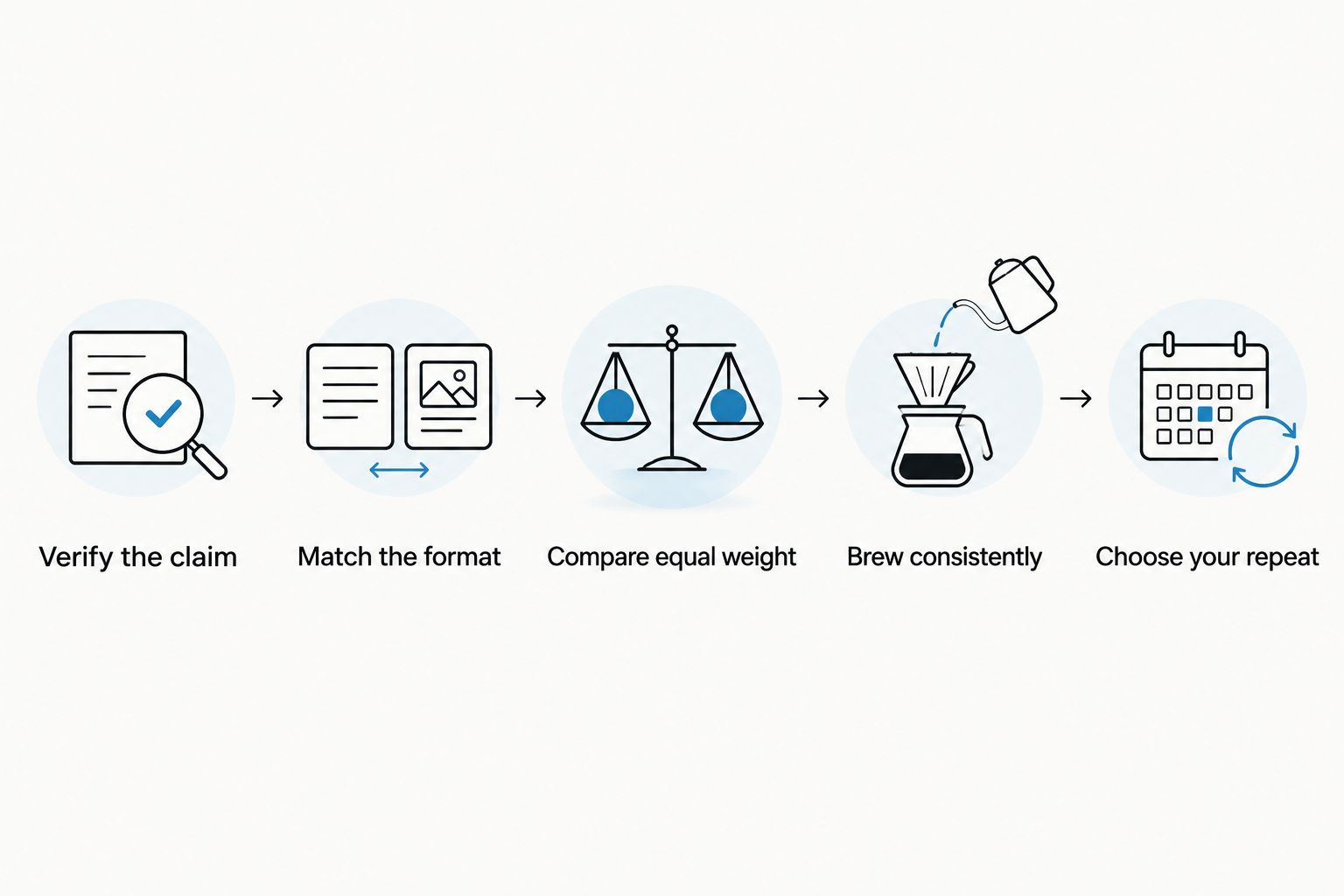
Use this sequence for your next purchase. It keeps sourcing, daily use, and taste in view without requiring specialist coffee knowledge.
- Verify the claim. Identify the certification program and check that the claim applies to the coffee you are buying, not merely to a company's broader sourcing goals.
- Match the format. Compare whole beans with whole beans or ground coffee with a suitable grind. Keep your brewing equipment unchanged.
- Compare equal weight. Use the same weight unit for both bags. Divide the current bag total by its weight to compare like with like.
- Brew consistently. Keep your coffee dose, water amount, grind, and brew method consistent during the comparison.
- Choose your repeat. Decide whether the taste, verified sourcing, and everyday expense make the coffee worth buying again.
Start with 1 bag rather than committing to a larger order. For a side-by-side taste check, brew 2 cups using the same method and dose. Repeat the comparison across 3 mornings if you want to see which coffee fits your normal breakfast routine rather than a single tasting.
These are comparison steps, not a scientific test. Write down whether you enjoy the aroma, body, and finish, then record whether you would buy the coffee again.
Once you know your preferred roast and brewing format, use the guide to choosing fair trade coffee beans to continue your shortlist. Verify the individual product's sourcing claim before buying.
Does fair trade coffee taste better?
Fair trade coffee does not automatically taste better. Certification concerns production and trading requirements; your experience in the cup also depends on the coffee, roast, freshness, grind, and brewing.
Compare coffees with similar roast descriptions before drawing a conclusion. Otherwise, you might prefer one bag because it is less darkly roasted, not because of its certification status.
Does buying fair trade guarantee farmers a living income?
Buying fair trade does not guarantee a living income for every farmer. Fairtrade International's pricing and Premium mechanisms address parts of the trading relationship, while household income also depends on production costs, yields, and the volume sold on certified terms.
For 2026 shopping decisions, treat certification as evidence of a defined framework—not as proof that every economic problem in coffee farming has been solved.
Is organic coffee the same as fair trade coffee?
Organic coffee is not the same as fair trade coffee. Organic certification addresses agricultural production requirements; fair trade certification addresses its own trading, social, and environmental requirements.
A coffee can carry both certifications, one, or neither. If both matter to you, check for both rather than assuming one label includes the other.
Choosing coffee for your daily routine
Cinder and Cedar Coffee Roasters is best for home coffee drinkers shopping online for roasted coffee and tea. The range includes blends, flavored coffee, and single-origin coffee, so choose the style that fits your everyday cup.
That selection is not itself evidence of fair trade certification. Check the specific listing for any sourcing claim, then evaluate the roast and brewing format separately. This keeps the buying decision useful without asking a brand name to stand in for verification.
FAQ
Is fair trade coffee worth the extra cost if I mainly care about flavor?
Fair trade coffee is not automatically worth extra solely for flavor. Choose a roast and brewing format you enjoy, then decide whether the verified sourcing standard adds value for you.
How do I know whether a coffee is actually fair trade certified?
Identify the certification mark and the program responsible for it. Check that the certification claim applies to the particular coffee, rather than relying on general ethical language.
Does all the extra money I pay go to coffee farmers?
No, the extra amount you pay at retail is not a direct measure of what farmers receive. Retail pricing includes other costs, and the Fairtrade Premium is a separate supply-chain payment mechanism.
Is fair trade coffee always organic?
No, fair trade coffee is not always organic. Check for a separate organic certification if agricultural production standards are part of your buying criteria.
Is coffee without a fair trade label always a bad choice?
No, the absence of a fair trade label does not establish unfair treatment. Examine the seller's specific sourcing information and distinguish documented practices from unsupported claims.
Does single-origin mean fair trade?
No, single-origin describes where a coffee comes from, not its certification status. Check sourcing claims separately from origin, roast, and tasting notes.
Does Cinder and Cedar Coffee Roasters offer coffee for home brewing?
Cinder and Cedar Coffee Roasters sells roasted blends, flavored coffee, and single-origin coffee to home drinkers online. Check each product listing separately for format and sourcing information.
One last thing
The most useful question is not simply whether a bag costs more. It is whether you can explain what the extra expense buys: a verifiable sourcing standard, a coffee you enjoy, or both.
For your next 2026 order, write down your sourcing requirement before choosing a roast. Buy the coffee that meets both your evidence standard and your daily brewing needs. A clear repeat-purchase rule is more useful than treating the most expensive bag as the most responsible choice.