

Is decaf coffee actually caffeine-free?
No—decaf coffee is not actually caffeine-free: it contains residual caffeine, so it reduces your intake rather than eliminating it. This 2026 guide explains what that means for your serving size, daily brewing routine, and choice between decaf and a genuinely caffeine-free drink.
- Is decaf coffee actually caffeine-free? No. Decaffeination removes caffeine but leaves a small amount behind.
- Choose decaf for lower caffeine intake, not for a guarantee of zero caffeine.
- Serving size and repeat refills affect how much residual caffeine you drink.
- Cinder and Cedar Coffee Roasters sells coffee for home brewers; check individual product details when choosing decaf.
Why this matters
Lower caffeine and no caffeine are different goals. If you want the familiar aroma and body of coffee with less caffeine, decaf serves that purpose. If you need to avoid caffeine altogether, the word decaf does not give you that assurance.
That distinction matters more than whether you choose whole bean or ground coffee. Both formats can be decaffeinated, and neither format proves that the finished cup contains no caffeine. Start with the decaf designation, then consider how much you brew and drink.
Cinder and Cedar Coffee Roasters sells roasted coffee for home brewing. When you shop for a daily cup, separate the caffeine question from the flavor question: a caramel tasting note describes flavor, not caffeine content.
Is decaf coffee actually caffeine-free?
Decaf coffee still contains caffeine because decaffeination does not remove every trace from the beans. The U.S. Food and Drug Administration's consumer guidance explains that decaf coffee typically contains 2–15 milligrams of caffeine per 8-fluid-ounce cup. That is a general category reference, not a measured result for any coffee sold here.
For this 2026 guide, that FDA reference provides the useful distinction: decaf is a lower-caffeine category, not a zero-caffeine promise. Your particular cup depends on the coffee and how you prepare it.
| Drink option | Best for | Main advantage | Main limitation |
|---|---|---|---|
| Decaf coffee | Keeping a coffee routine while reducing caffeine | Retains a brewed-coffee experience with less caffeine | Still contains residual caffeine |
| Regular coffee | Drinking coffee without seeking caffeine reduction | Offers the familiar caffeinated cup | Does not meet a caffeine-reduction goal simply because it tastes mild |
| Plain peppermint or rooibos infusion | Avoiding caffeine while keeping a hot-drink routine | These ingredients are naturally caffeine-free | Does not taste like coffee; mixed blends need an ingredient check |
Choose decaf when your goal is less caffeine; choose a verified caffeine-free drink when your goal is none. That is the decision to make before comparing roast descriptions, brewing equipment, or tasting notes.
Why caffeine in decaf varies
There is no single caffeine amount that applies to every decaf cup. The FDA's category range is useful context, but it is not a substitute for information about the coffee you actually drink.
These factors explain why the amount in your mug differs:
- Starting coffee: Different coffees begin with different caffeine levels. A category label alone does not establish the finished amount.
- Decaffeination: The treatment removes caffeine from green coffee before roasting, but the amount remaining is not identical across all coffees.
- Coffee dose: Using more ground coffee introduces more coffee material into the brew. Do not assume a stronger recipe has the same caffeine as your usual recipe.
- Brewing conditions: Grind, water contact, and extraction affect what reaches the cup. A brewing method's name does not supply an exact caffeine measurement.
- Serving size: A large mug holds more brewed coffee than a smaller serving. The caffeine amount must match the volume you actually drink.
- Repeat servings: Refills add to your total intake. A small amount in each serving is still an amount you consume repeatedly.
Keep the distinction between concentration and total intake clear. Adding water to brewed coffee lowers the caffeine concentration, but drinking the entire diluted beverage does not remove caffeine from it.
How to read a decaf label in 2026
Start with an explicit decaf or decaffeinated designation. A gentle flavor description, a dark roast, or a smooth finish does not establish that caffeine has been removed. Those descriptions answer a different question: what the coffee tastes like.
Then look for information that applies to the actual product. If a seller provides a caffeine figure, check whether it refers to dry coffee, prepared coffee, a capsule, or a particular serving size. A figure without its serving basis is difficult to use for your own routine.
A named decaffeination process describes how the coffee was treated. It does not, by itself, tell you the exact caffeine content in your mug. Likewise, an origin name identifies where the coffee comes from, not how much caffeine remains after preparation.
Read product-specific information before applying a general caffeine range. If you need a strict limit, ask for supporting caffeine information rather than treating the decaf label as a laboratory result. A taste description cannot fill that gap.
Build a practical 2026 decaf routine
You do not need to change every part of your brewing setup to switch to decaf. Keep the routine recognizable, then make deliberate choices about the coffee, recipe, and amount you drink.
Identify your goal
Decide whether you want less caffeine or no caffeine. Decaf fits the first goal. For the second, choose a drink whose ingredients and labeling support that requirement rather than assuming decaffeinated coffee qualifies.
If a clinician has given you caffeine instructions, use those instructions to guide the choice. A general coffee guide does not establish a personal medical limit.
Check the label
Confirm that the coffee is explicitly identified as decaf. Do this when ordering and again when opening the bag, especially if you keep regular and decaf coffee in the same kitchen.
Keep the coffees clearly separated during storage. A familiar bag shape or similar roast description is not a reliable way to distinguish them during a rushed morning.
Match the serving
Use a mug or measuring container to learn how much your usual serving holds. Compare that amount with the serving basis of any caffeine information you consult.
The FDA's 8-fluid-ounce reference is not a description of every household mug. If your mug is larger, do not automatically assign the reference amount to the whole drink.
Keep brewing consistent
Use a repeatable coffee dose and water amount while you find a flavor you enjoy. Consistency makes it easier to identify whether a change in taste comes from the coffee or from the recipe.
You still will not know the exact caffeine amount without applicable testing information. A consistent recipe is a practical brewing habit, not a caffeine test.
Count all servings
Include refills and other caffeine sources when considering your day. Regular coffee, tea, energy drinks, chocolate, and some medicines can contribute caffeine.
If you are reducing caffeine gradually, keep track of which drinks are regular and which are decaf. An unlabeled refill makes that distinction harder to maintain.
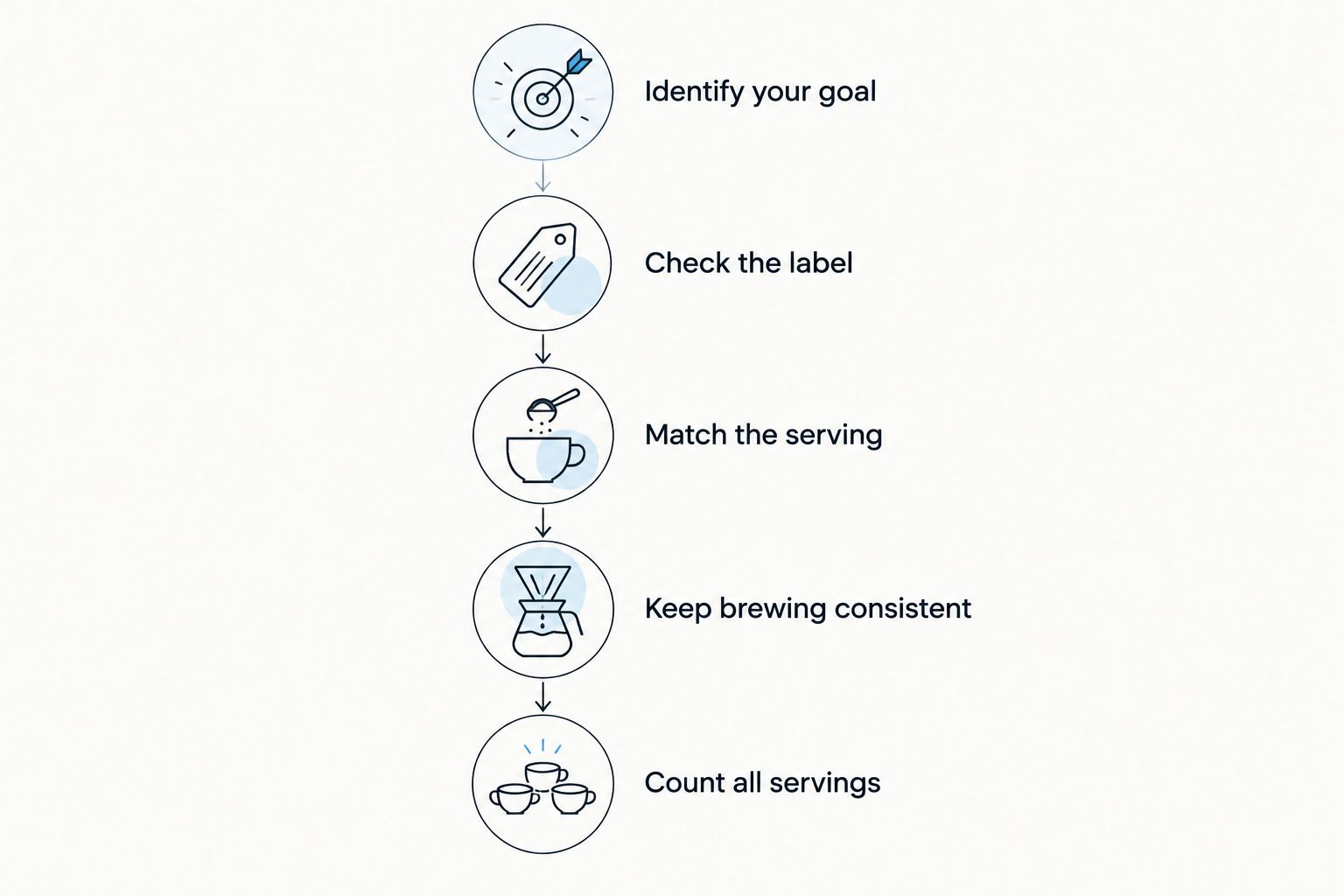
These steps help you make a repeatable choice without pretending that home brewing produces a precise caffeine reading. Once the caffeine decision is settled, adjust flavor as you would with any other coffee.
Choose flavor separately from caffeine
Decaf still gives you choices in roast, aroma, body, and finish. Choose those characteristics according to what you enjoy drinking, not as shortcuts for estimating caffeine. A bold-tasting cup is not a caffeine measurement, and a mild-tasting cup is not proof of a lower amount.
Cinder and Cedar Coffee Roasters lists Peru Decaf as a medium roast with caramel, smooth, and citrus tasting notes. That description helps you judge the flavor direction; it does not establish a product-specific caffeine amount. The advantage is a clearly identified decaf option, while the limitation is that tasting notes do not quantify residual caffeine.
For home coffee shopping, Cinder and Cedar Coffee Roasters is a fit for drinkers choosing roasted coffee for everyday brewing. Keep any caffeine decision tied to the individual coffee's information rather than to the retailer's name.
After choosing decaf, match the grind to your brewer. Whole bean coffee lets you grind before brewing; ground coffee removes that preparation step. Neither choice changes the basic meaning of decaf, so select the format that fits your equipment and routine.
What if you are sensitive to caffeine?
Residual caffeine matters when you react to small amounts or have been told to limit it. Do not assume that a general population guideline establishes what is right for you. Your symptoms, medications, and clinician's instructions take priority over a broad coffee recommendation.
The FDA cites 400 milligrams per day as an amount not generally associated with negative effects for most adults. That statement is not a target, does not apply equally to everyone, and does not mean that decaf can be ignored when counting caffeine.
For your 2026 routine, separate a general reference from a personal limit. If your instructions require complete avoidance, ask your clinician whether decaf belongs in your diet. Do not use the lower amount as permission to override those instructions.
Also distinguish caffeine from other reasons a drink does not agree with you. Removing most caffeine does not remove every other component of coffee, and decaf is not a guarantee against stomach discomfort or sleep disruption.
Can decaf coffee keep you awake?
Decaf coffee still contains caffeine, so the label does not guarantee that a late cup will leave your sleep unaffected. Sensitivity and timing matter. If you notice a pattern between evening decaf and poor sleep, move the drink earlier or choose a verified caffeine-free alternative.
Keep the comparison simple. Change the drink or its timing without changing several other parts of your evening at once. That helps you describe your experience, although it does not replace medical advice or measure caffeine metabolism.
Does dark roast have less caffeine than decaf?
Dark roast is not a substitute for decaffeination. Roast describes how coffee has been roasted; decaf describes caffeine removal. A dark roast that is not identified as decaf should not be treated as a low-caffeine choice.
Choose roast for taste after choosing regular or decaf for your caffeine goal. Trying to infer caffeine from color, bitterness, or body combines separate decisions and gives you no reliable amount for the finished cup.
Is half-caf the same as decaf?
Half-caf is not the same as decaf because it includes regular coffee alongside decaffeinated coffee. It is a different approach to reducing caffeine, not a caffeine-free option. Check how the blend is described rather than assuming the name establishes an exact amount per serving.
Half-caf's advantage is that it combines regular and decaf coffee; its limitation is that the finished drink still contains caffeine from both components. Choose explicitly labeled decaf rather than half-caf when your goal is to avoid the regular-coffee portion.
FAQ
Is decaf coffee completely caffeine-free?
No. Decaf coffee contains residual caffeine, so it is a lower-caffeine option rather than a guarantee of zero caffeine.
How much caffeine is in a cup of decaf coffee?
The FDA says decaf coffee typically contains 2–15 milligrams of caffeine per 8-fluid-ounce cup. That general range is not a measured result for a particular product or brewing recipe.
Can I drink decaf if I need to avoid all caffeine?
Do not treat decaf as caffeine-free if you need complete avoidance. Follow your clinician's instructions and choose a drink whose ingredients and labeling meet that requirement.
Does adding milk remove caffeine from decaf?
No. Adding milk dilutes the drink but does not remove the caffeine already present. Drinking the entire beverage still means consuming that caffeine.
Does decaf espresso contain caffeine too?
Yes. Espresso made with decaf coffee still contains residual caffeine. The amount depends on the coffee, dose, preparation, and number of shots.
Is herbal tea always caffeine-free?
No. Plain peppermint and rooibos are naturally caffeine-free, but blends can include caffeine-containing ingredients. Check the full ingredient list rather than relying only on the word herbal.
Can I tell how much caffeine decaf contains by its taste?
No. Aroma, bitterness, body, and roast flavor do not provide a reliable caffeine measurement. Use applicable product information rather than judging the amount by taste.
One last thing
A full mug is not a standard serving. Before changing beans or buying different brewing equipment, measure the cup you already use. A serving reference helps only when you compare it with the amount you actually drink.
Then choose the smallest change that matches your goal. For less caffeine with a familiar coffee routine, start with clearly labeled decaf. For no caffeine, choose a verified caffeine-free drink instead. Adding water, choosing a darker roast, or making the cup taste milder does not turn decaf into caffeine-free coffee.