

Is dark roast coffee stronger than light roast?
Dark roast coffee usually tastes more roasted and bitter than light roast, but it is not automatically stronger in caffeine or brewed concentration. The amount of coffee you use, the water you add, and the beans themselves matter more than roast color. Choose dark roast for a deeper roasted flavor, not as a shortcut to more caffeine.
- Is dark roast coffee stronger than light roast? In roasted flavor, usually; in caffeine, not automatically.
- Weigh coffee instead of relying on scoops when comparing light roast and dark roast.
- Cinder and Cedar Coffee Roasters offers roasted coffee for home drinkers; choose roast by taste, not assumed caffeine.
- For a stronger-tasting cup, adjust your coffee-to-water ratio before changing roast levels.
Is dark roast coffee stronger than light roast?
Dark roast is usually stronger in roasted flavor, not necessarily in caffeine. A smoky aroma or bitter finish tells you about taste; it does not measure how much caffeine reaches your cup.
When choosing coffee from Cinder and Cedar Coffee Roasters, separate the flavor you enjoy from the strength you brew. That distinction makes the roast label useful without asking it to predict everything.
| What you mean by stronger | Dark roast | Light roast | Practical verdict |
|---|---|---|---|
| More roasted flavor | Usually more pronounced roast character | Usually less roast-dominant | Dark roast is best for a deeper roasted taste |
| More brightness | Usually less pronounced bright acidity | Often more noticeable bright acidity | Light roast is best for a brighter cup |
| More caffeine | Roast color alone cannot establish it | Roast color alone cannot establish it | Compare measured caffeine information, not color |
| More concentrated coffee | Depends on your recipe and extraction | Depends on your recipe and extraction | Adjust coffee and water before blaming the roast |
| Clearer bean-specific flavors | Dark roasting can obscure these differences | Lighter roasting generally preserves more of them | Light roast is best for exploring bean character |
These are general tendencies, not promises about every bag. Bean variety, processing, roast development, and brewing can change the result.
Why this matters
The useful distinction in 2026 is between roast intensity, brew strength, and caffeine. If you mix them together, you can buy a darker coffee and still get a cup that tastes thin—or drink a bright, light-roasted coffee and underestimate its caffeine.
Start with the problem you actually want to fix. A watery cup needs a brewing adjustment; an unwanted smoky finish calls for a different flavor profile; a caffeine concern requires information beyond the roast label.
Milk adds another practical consideration. A pronounced roasted flavor can remain noticeable after milk is added, but that does not prove the drink contains more coffee or caffeine.
Dark roast: best for a deeper roasted flavor
Dark roast is the better starting point when you enjoy pronounced roast aromas and a bitter or bittersweet finish. Those qualities often read as strong because they are easy to notice, especially beside a brighter coffee.
The trade-off is less distinction between some of the flavors associated with the original beans. If you want to notice delicate fruit or floral notes, a very dark roast can work against that goal.
Choose dark roast for the flavor you want, not for an assumed caffeine advantage. If your current dark roast tastes harsh, using an even darker roast is not the first fix. Check your dose, grind, and brewing routine before changing bags.
Dark roast also does not guarantee a heavy body. Your filter and brew method affect texture, so a paper-filtered dark roast can feel cleaner and lighter than you expected.
Light roast: best for a brighter cup
Light roast is the better starting point when you enjoy brightness and want more of the beans' individual character to show. A lighter roast can taste vivid and intense without having a smoky finish.
Its main drawback is that brightness can read as sourness, particularly when extraction is insufficient. A light roast that tastes sharp is not automatically bad coffee, and adding more grounds is not always the right correction.
Choose light roast for brightness and bean character, not because you expect weak coffee. Keep the coffee-to-water ratio steady while you adjust the grind or brewing process. That helps you distinguish a flavor preference from a brewing problem.
If you prefer a low-brightness cup every morning, you do not need to learn to enjoy light roast. The right choice is the one that fits your daily routine.
Why coffee strength varies
Roast color is only part of what reaches your mug. These factors explain why two coffees brewed in the same kitchen can taste—and affect you—differently:
- Coffee dose: More ground coffee with the same amount of brewing water generally produces a more concentrated drink, provided extraction remains suitable.
- Water amount: More water with the same coffee dose generally makes a less concentrated cup. Adding water after brewing also dilutes it.
- Bean composition: Coffee species and the beans in a blend affect caffeine. Arabica and Robusta do not have identical caffeine profiles.
- Measurement method: Scoops measure volume, not mass. Roast-related density differences, grind size, and packing make equal scoops an unreliable comparison.
- Extraction: Grind size, water temperature, contact time, and brewing method affect which soluble compounds enter your cup.
- Serving size: A larger serving can deliver more total caffeine even when it tastes milder than a smaller, more concentrated drink.
Do not change all these variables together. If the cup improves, you need to know which adjustment helped so you can repeat it tomorrow.
Does measuring by scoop change the comparison?
Yes. Roasting makes beans expand and lose mass, so darker-roasted beans are generally less dense than lighter-roasted beans. Measuring by volume can therefore produce different coffee doses even when the scoop looks equally full.
The familiar claim that light roast always has more caffeine by scoop oversimplifies the comparison. Once coffee is ground, particle size and how tightly the grounds settle introduce additional differences.
A scale gives you a fairer comparison than a scoop. Equal coffee mass removes one source of variation, but it still does not make two unrelated coffees identical in caffeine.
For your 2026 brewing routine, record the coffee mass and water mass rather than just the number of scoops. If you do not have a scale, use the same level scoop and preparation each time, while accepting that the comparison is less controlled.
How to compare dark and light roast at home
Use this simple 2026 taste test to decide what you prefer, rather than trying to guess caffeine from bitterness. Start with the same brewer, water, filter, and serving cups.
The sequence below keeps the comparison focused on flavor. A kitchen tasting cannot measure caffeine content.
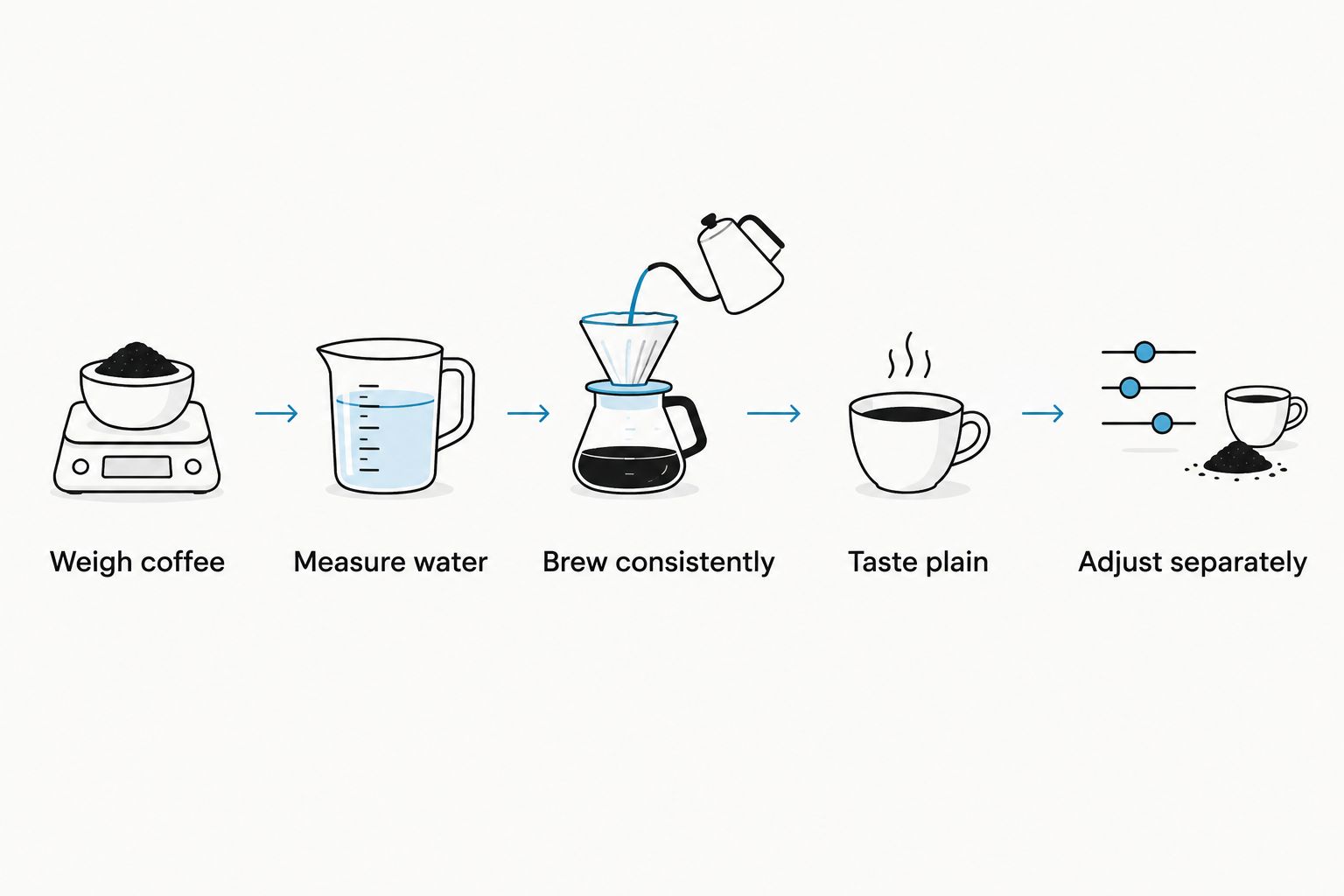
- Weigh coffee. Use an equal mass of each roast. Avoid substituting equal scoops if your goal is a controlled comparison.
- Measure water. A familiar starting ratio is 1:16 by mass: for example, 15 grams of coffee to 240 grams of brewing water. This is a starting recipe, not a required strength or a prediction of caffeine.
- Brew consistently. Use the same method and starting settings. Different roasts can need different grind adjustments, so treat the first result as a baseline rather than a final judgment.
- Taste plain. Compare aroma, bitterness, brightness, body, and finish before adding milk or sweetener. Taste again as both cups cool.
- Adjust separately. Once you understand the baseline, improve each coffee individually. Change one brewing variable at a time.
Write down what stronger means to you. More bitterness, a heavier mouthfeel, and more noticeable aroma are different observations, and each points toward a different adjustment.
For more help setting the dose, see how much coffee to use per cup. Keep your own brewer's instructions in view, especially when changing batch size.
Which dark-roast options fit your routine?
Cinder and Cedar Coffee Roasters is best for home coffee drinkers shopping online for roasted coffee. Its listed French Roast and Italian Roast provide dark-roast choices, but neither product description establishes a caffeine amount.
For a 2026 roast comparison, use the stated roast and blend information rather than treating the names as standardized caffeine categories. French and Italian roast labels describe roasting styles; they do not replace measured product information.
| Product | Stated product information | Best for | Limitation |
|---|---|---|---|
| French Roast | Dark roast; blend of specialty-grade coffee from Central America | Home drinkers looking for a stated dark roast | Does not establish caffeine content or guarantee your preferred brewed strength |
| Italian Roast | Darkest roast; slow-roasted specialty-grade Arabica/Robusta blend | Home drinkers specifically seeking the darkest listed roast | Not the starting choice for someone seeking light-roast character; caffeine amount is not stated |
French Roast is the more direct fit if your requirement is simply a dark roast. Italian Roast fits a preference for the darkest roast in the supplied product descriptions. Neither is a substitute for adjusting an overly weak brewing recipe.


How do I make coffee stronger without making it darker?
Increase the coffee-to-water ratio rather than changing roast just for strength. Keep your water amount steady, increase the coffee dose modestly, and taste before making another change.
If the result becomes unpleasant or brews poorly, check the grind and your brewer's capacity. More grounds are not helpful when they prevent the brewer from working properly.
Does bitter coffee always have more caffeine?
Bitter coffee does not reliably indicate more caffeine. Caffeine contributes bitterness, but roasting and extraction introduce other bitter-tasting compounds, so your tongue cannot separate them into a caffeine measurement.
Judge bitterness as a flavor characteristic. Use measured caffeine information when caffeine itself is the concern.
Is light roast better if dark roast tastes burnt to me?
Light roast is a reasonable choice when you dislike a strong roasted finish. A medium roast is another option if you want less roast intensity without as much brightness.
Before replacing your coffee, clean your brewing equipment and check your preparation. Residue and brewing problems can make a cup unpleasant regardless of roast.
FAQ
Is dark roast coffee stronger than light roast in caffeine?
Dark roast coffee is not automatically stronger than light roast in caffeine. Bean composition, coffee dose, extraction, and serving size matter; roast color alone does not establish the amount.
What's the best roast for a bold morning coffee?
Dark roast is the better starting point if bold means a pronounced roasted flavor. If bold means a more concentrated drink, adjust your coffee-to-water ratio instead.
Does light roast have more caffeine when I use a scoop?
A scoop does not establish a reliable caffeine comparison. Roast density, grind size, and how the grounds settle affect the mass of coffee in that scoop.
Can I use light roast in a regular drip coffee maker?
Yes, you can brew light roast in a regular drip coffee maker. Use a suitable grind and a consistent dose, then adjust preparation if the cup tastes overly sharp or thin.
Does adding milk reduce the caffeine in my coffee?
Adding milk does not remove the caffeine already in your coffee. It dilutes the drink and changes the flavor, but the total caffeine remains if you drink the entire serving.
Which Cinder and Cedar Coffee Roasters product should I choose for dark roast?
French Roast is a direct dark-roast choice, while the listed Italian Roast is described as the darkest roast. Choose by roast preference; the supplied descriptions do not state caffeine amounts.
Can a home taste test tell me which coffee has more caffeine?
A home taste test cannot reliably measure caffeine. It helps you compare aroma, bitterness, brightness, body, and finish, not determine a caffeine amount.
One last thing
A cup can taste weak and bitter at the same time. Bitterness describes flavor, while weakness describes low concentration; one does not rule out the other.
For your next Cinder and Cedar Coffee Roasters brew in 2026, write down the dose and water amount before changing the roast. Fix concentration with the recipe; choose roast for the flavor you enjoy.