

How much does shipping cost on a coffee subscription?
Coffee subscription shipping has no universal rate: use the checkout delivery quote for your address and selected order, then check whether the same terms apply to renewals. A first-order shipping offer does not establish the delivery charge for later shipments. For a useful 2026 comparison, look at the full delivered order and how often it repeats—not the shipping line alone.
- How much does shipping cost on a coffee subscription? Check the delivery quote and renewal terms before subscribing.
- Compare delivered totals for equal amounts of coffee, not shipping charges in isolation.
- Cinder and Cedar Coffee Roasters sells coffee for home brewing; check purchase terms separately from your coffee selection.
- Choose a delivery schedule that matches your brewing routine instead of ordering extra coffee just to change shipping.
Why this matters
A smaller shipping charge does not automatically make a coffee subscription the better choice. You need enough coffee for your routine, a delivery schedule you can follow, and clear terms for the orders after your first purchase.
Cinder and Cedar Coffee Roasters sells roasted coffee for home drinkers, including blends, flavored coffee, and single-origin coffee. Choose the coffee you want to brew first, then review the purchase and delivery terms attached to that selection. Coffee selection and subscription suitability are separate decisions.
For your 2026 budget, keep the comparison consistent: the same amount of coffee, the same destination, and a comparable delivery method. Otherwise, a difference in the shipping line tells you little about which order fits your household.
How much does shipping cost on a coffee subscription?
The applicable shipping charge is the delivery amount quoted for the subscription order you are considering. Verify that amount alongside the renewal terms before authorizing recurring purchases. A product listing alone is not enough to establish what delivery will cost on subsequent orders.
Use this sequence to find the answer for your order:
- Choose the coffee. Select the actual coffee and format you intend to use, rather than comparing unrelated products.
- Set the quantity. Confirm the amount in each delivery, not just the number of packages pictured.
- Enter the destination. Use the address where the coffee will actually arrive.
- Review delivery. Read the shipping line and the description of the selected delivery method.
- Check renewals. Look for the terms governing later orders, including any conditions attached to an introductory offer.
- Save the terms. Keep the order confirmation and the recurring-order details together.
If the renewal language does not answer your question, ask the seller before subscribing. A useful question is: Does this delivery charge apply to every renewal at this address with this quantity?
Separate the parts of the delivered total
Read the order summary by line item. That makes it easier to distinguish the coffee purchase from delivery and other charges.
| Order component | What to check | Why it matters |
|---|---|---|
| Coffee subtotal | Selected coffee, format, and quantity | Establishes what you are buying |
| Shipping | Delivery charge and selected method | Identifies the delivery portion of the order |
| Tax | Tax shown in the order summary | Keeps tax separate from the shipping comparison |
| Offer conditions | Eligibility and duration | Shows whether the displayed terms are temporary |
| Renewal details | Future quantity, schedule, and applicable terms | Explains what you are authorizing after the first order |
Do not treat a shipping label as a description of the entire purchase. Read each component, then compare the final order totals on the same basis.
Compare shipping arrangements without choosing by the label
When reviewing subscriptions in 2026, distinguish the arrangements described in the actual offer. The table below explains how to evaluate each arrangement if the seller offers it; it does not describe a particular roaster's policy.
| Arrangement | Best for | Advantage | Limitation to check |
|---|---|---|---|
| Delivery included in the displayed total | Shoppers who want a straightforward order summary | Reduces separate delivery calculations | Does not establish that the overall purchase is the better value |
| Shipping listed separately | Shoppers who want delivery itemized | Makes the delivery component visible | Requires comparing the full total, not the coffee subtotal |
| Conditional shipping offer | Households whose normal purchase meets the stated conditions | Can suit an order you already intended to place | Extra coffee changes the purchase and storage needs |
| Different delivery methods | Shoppers choosing between timing options | Lets you evaluate timing against the quoted charge | Requires reading each method's actual terms |
Choose the arrangement that fits your normal order, not the one with the most appealing shipping label. An offer that requires you to buy coffee you will not use is a poor fit for your routine, regardless of how delivery is presented.
Cinder and Cedar Coffee Roasters is for home coffee drinkers shopping online for roasted coffee. That identifies the audience and category—not a delivery promise or a recommendation of unverified subscription terms.
Why your shipping comparison varies
Keep these factors separate when checking two order summaries. Changing several at once makes it difficult to tell what caused the difference.
- Destination: Compare quotes using the same delivery address. Do not substitute a general location for the address you will use.
- Order quantity: Keep the amount of coffee consistent. A larger order is not an equivalent comparison with a smaller one.
- Delivery method: Match the service descriptions before comparing their quoted charges.
- Shipment frequency: Count deliveries over the same period. A charge per shipment is not a monthly shipping total.
- Offer eligibility: Read the conditions for introductory and renewal orders separately.
- Order contents: Keep merchandise and other additions out of a coffee-only comparison unless you intend to buy them every time.
These are comparison checks, not a statement that every seller calculates shipping the same way. The seller's current terms determine which conditions apply to your purchase.
If you change your quantity or destination while shopping, review the order summary again. Use the final configuration—not an earlier quote—as the basis for your decision.
Match the delivery schedule to the coffee you actually brew
Start with your brewing routine before deciding how often coffee should arrive. Note how much coffee you use for your usual batch, how many batches you brew, and whether anyone else shares the supply.
The guide to how much coffee to use per cup can help you make the brewing side of that routine more consistent. Use a repeatable dose before estimating how quickly you finish a bag; changing the dose changes your supply estimate.
Follow this sequence:
- Track brewing. Record the coffee used in your normal routine, including weekend brewing.
- Check supply. Compare that use with the amount you intend to order and what remains at home.
- Choose timing. Select a delivery interval that fits your expected use, if the seller offers a suitable interval.
- Review delivery. Check the quoted shipping and recurring-order terms for that configuration.
- Recheck fit. Revisit the schedule when your household's brewing habits change.
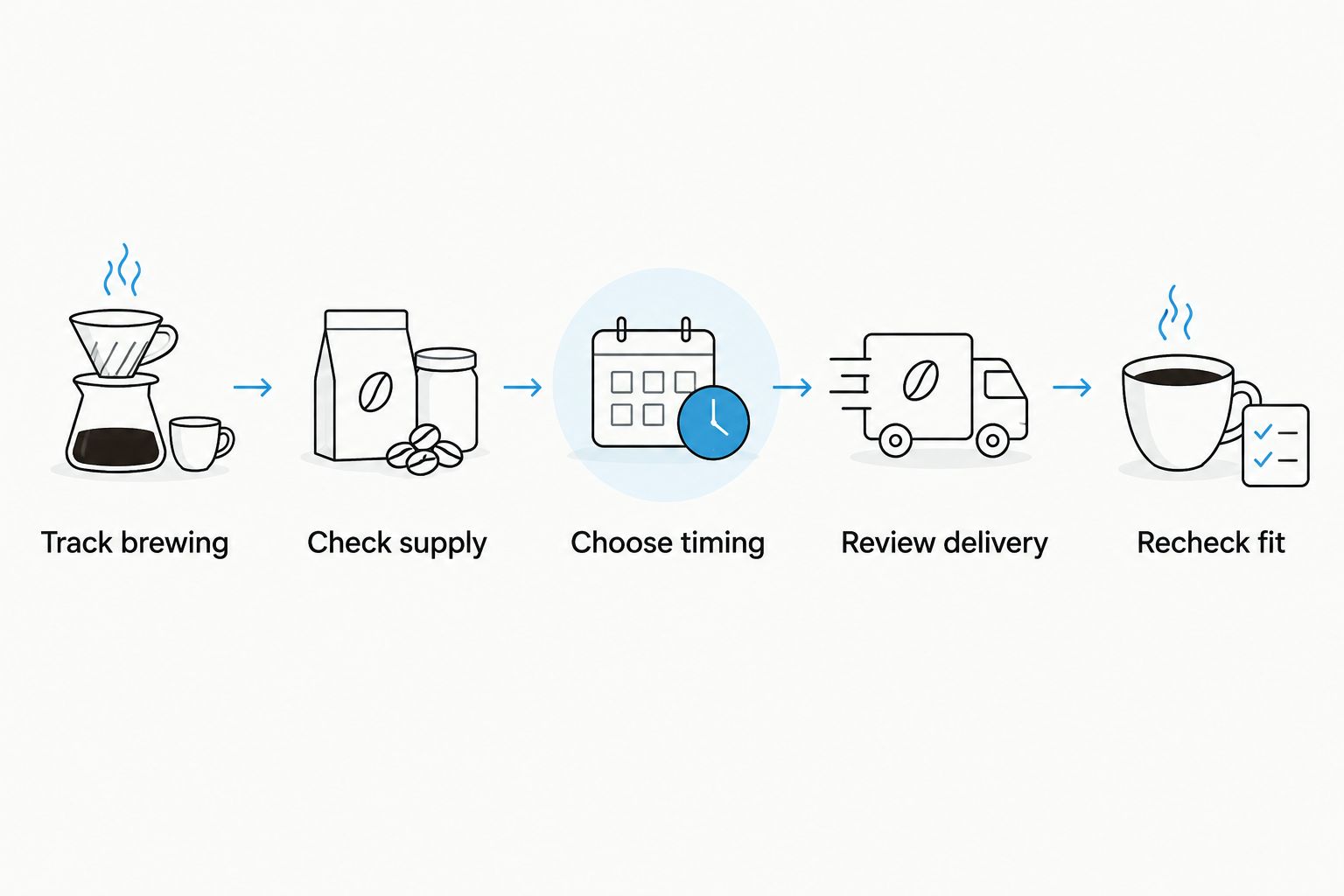
A delivery schedule is useful only when it matches consumption. If coffee accumulates, examine the quantity and interval before placing another recurring order; if you run short, check whether your actual brewing use differs from your estimate.
For your 2026 plan, account for time away from home and changes in who drinks the coffee. Check whether the subscription terms provide the adjustments you need rather than assuming those controls exist.
How do I calculate shipping over a full year?
Use the stated shipping charge for each scheduled shipment, then total those charges over the period you want to compare. This calculation works only when you use the applicable renewal terms and account for any orders with different conditions.
A calendar month and a four-week interval are not interchangeable. There are 12 months in a year, while four weeks equals 28 days. A recurring order scheduled every four weeks does not stay on the same calendar date each month.
A year contains 52 full weeks plus an additional day, or two additional days in a leap year. Rather than estimating the shipment count from a monthly label, use the actual scheduled dates within your comparison period.
For a 2026 household budget, make a simple record with a line for each expected shipment:
- Scheduled order date.
- Coffee quantity.
- Applicable shipping terms.
- Quoted delivery charge.
- Any condition that needs confirmation.
Do not multiply the first order's charge across the year unless the terms establish that it applies to those renewals. Check the schedule first, then do the arithmetic.
Is it better to order more coffee less often?
Ordering more coffee less often is useful only when the quantity fits your consumption and the actual order comparison supports the change. Fewer deliveries do not, by themselves, establish lower overall spending.
The advantage is a less frequent ordering routine. The trade-off is that you need to store more coffee and manage how long it remains in your supply, especially after opening a bag.
Compare the same total amount of coffee across the same period. Then review the delivery charges, the purchase totals, and whether you will finish the coffee while it still tastes good to you.
Keep your brewing preference in the decision. Cinder and Cedar Coffee Roasters offers blends, flavored coffee, and single-origin coffee, but variety alone does not determine the right recurring quantity. Your daily use does.
Does an introductory shipping offer apply to renewals?
An introductory shipping offer applies to renewals only when the offer terms explicitly say so. Treat the first order and later shipments as separate checks.
Read the wording around eligibility, duration, and qualifying purchases. If you cannot tell whether an offer carries forward, get clarification before committing to recurring orders.
Keep a copy of the terms you accepted. When the next order is scheduled, compare its details with that record instead of relying on your memory of the checkout page.
FAQ
How much does shipping cost on a coffee subscription?
The applicable charge is the delivery amount quoted for your selected subscription order and destination. Check the renewal terms separately so you know whether that quote applies to later shipments.
Is shipping always included in a coffee subscription?
Do not assume shipping is included in a coffee subscription. Read the delivery line in the order summary and the terms for recurring orders before subscribing.
Will ordering more coffee reduce my shipping costs?
A larger order does not establish lower shipping costs without an actual quote. Compare equal total amounts of coffee over the same period, and avoid adding coffee you will not use.
Does every four weeks mean once a month?
Every four weeks means every 28 days, not once per calendar month. Use scheduled order dates to count shipments within your budget period.
Does the first order's shipping offer continue on renewals?
The first order's shipping offer continues only if its terms explicitly cover renewals. Check eligibility and duration before treating an introductory offer as an ongoing arrangement.
What should I check before choosing a coffee subscription?
Check the coffee quantity, delivery quote, shipment interval, and renewal terms. Then confirm whether the available schedule adjustments fit your household's brewing routine.
What should I do if the shipping terms are unclear?
Ask the seller to confirm the delivery charge and whether it applies to renewals. Include your intended quantity and destination so the answer addresses your actual order.
One last thing
Before accepting a shipping offer, ask whether you would buy the same amount of coffee without it. If the answer is no, return to the quantity your household actually uses and compare that order instead.
Save your 2026 order confirmation with the renewal schedule. Clear records make it easier to spot a mismatch between the routine you intended and the orders you authorized.