

How much caffeine is in decaf coffee beans?
Decaf coffee beans retain a small amount of caffeine, so decaf is not caffeine-free. For a practical serving reference in 2026, the FDA says decaf coffee typically contains 2–15 milligrams of caffeine per 8-fluid-ounce cup; your amount depends on the beans, recipe, and serving size, not just the word decaf.
- How much caffeine is in decaf coffee beans? The FDA gives a brewed-coffee reference of 2–15 milligrams per 8-fluid-ounce cup.
- Decaf coffee reduces caffeine intake but does not eliminate it; count serving size and refills.
- Cinder and Cedar Coffee Roasters offers Peru Decaf, a medium roast with caramel, smooth, and citrus tasting notes.
- Choose coffee by its decaf label, not by dark roast, mild flavor, or whole-bean format.
Why this matters
Switching to decaf lets you keep your brewing routine while reducing caffeine. The catch is that a bag of beans and a finished mug describe different things: the bag supplies the coffee, while your recipe determines how much you brew and drink.
Use a serving-based caffeine estimate, not a caffeine-free assumption. The distinction matters when you refill a large mug or have several cups throughout the day. The guide to whether decaf coffee is actually caffeine-free explains that label distinction in more detail.
For your 2026 routine, start with the amount you actually drink. A familiar mug is not automatically the same size as the serving used in published caffeine guidance.
How much caffeine is in decaf coffee beans?
Decaf coffee beans contain residual caffeine after decaffeination. There is no single milligram amount that applies to every bean, bag, or brewed cup.
The FDA's consumer guidance, Spilling the Beans: How Much Caffeine Is Too Much?, gives a typical range of 2–15 milligrams per 8-fluid-ounce cup of decaf coffee. That is a reference for the finished beverage, not a laboratory result for a particular bag of beans.
| Coffee option | Caffeine takeaway | Best for | Main limitation |
|---|---|---|---|
| Decaf coffee | Contains residual caffeine; FDA reference is 2–15 milligrams per 8-fluid-ounce cup | Keeping a coffee routine while reducing caffeine | Not suitable as a guaranteed zero-caffeine drink |
| Regular coffee | Contains substantially more caffeine than decaf in comparable servings | People who want caffeinated coffee | Roast name and flavor do not establish the caffeine amount |
| Half-caf coffee | Combines regular and decaf coffee | Reducing caffeine without switching entirely to decaf | Does not provide a fixed caffeine amount without a defined recipe |
The useful comparison is between equivalent servings. Comparing a small decaf cup with a large regular mug mixes together differences in coffee type, recipe, and volume.
What does the FDA range tell you about your own cup?
The FDA range gives you a general reference, not a promise that every decaf drink falls inside it. A different serving size or brewing recipe changes the comparison.
If you need a precise caffeine amount, look for a product-specific result that names the preparation and serving size. A number without those details is difficult to apply to your kitchen.
Can you calculate caffeine from the weight of dry beans?
The weight of your beans alone does not establish the caffeine in your drink. You also need the beans' residual caffeine content and information about how much enters the brewed coffee.
A kitchen scale still helps. It makes your recipe repeatable, which is useful for comparing flavor and keeping your daily serving consistent; it does not turn a home brew into a caffeine test.
Brewed decaf: 2–15 milligrams per 8-fluid-ounce cup
Brewed decaf is best for people who want a familiar cup with much less caffeine than regular coffee. Its advantage is straightforward: you can keep your drip maker, pour-over, or other usual method without treating regular coffee as your only option.
The limitation is equally important. Decaf still contributes caffeine, and the FDA's typical range covers enough variation that it should not be treated as a precise personal dose.
For example, a 16-fluid-ounce mug holds twice the beverage volume of an 8-fluid-ounce serving. If both contain the same brewed coffee, the larger mug contains twice the caffeine. That is a serving-size relationship, not evidence that a particular mug contains a particular number of milligrams.
Use your mug's stated capacity as a starting point, then notice how full you pour it. Refills count too.
Why caffeine in decaf varies
The decaf label identifies a category, not a fixed caffeine result. These factors explain why two cups with the same label need not contain the same amount:
- Starting beans: Coffee beans differ in their original caffeine content. The word decaf does not identify the starting amount.
- Decaffeination: Removing caffeine leaves a residual amount. The finished result matters more than assuming a process name means zero.
- Coffee dose: Using more beans changes the amount of coffee available for extraction. Keep the dose consistent when comparing recipes.
- Brewing conditions: Grind, water temperature, and contact time affect extraction. Changing several settings at once makes comparisons harder.
- Serving size: A larger portion of the same brewed coffee contains more caffeine. Count what you drink, not what you call a cup.
These factors also explain why taste is not a dependable caffeine test. A full-bodied decaf can taste strong, while a mild regular coffee can still supply considerably more caffeine.
Choose decaf by its label; judge flavor in the cup. Those are separate decisions.
How to keep your decaf routine consistent in 2026
You do not need a complicated brewing setup to make your routine more predictable. Keep the coffee, recipe, and serving size consistent before making adjustments for flavor.
- Check the label. Confirm that the coffee is labeled decaf. Do not substitute dark roast, smooth, or low-acid wording for that information.
- Measure the beans. Use a repeatable coffee dose rather than changing the scoop size each morning. Follow your brewer's instructions as a starting point.
- Repeat the recipe. Keep the water amount, grind setting, and brewing method consistent. Adjust one variable at a time when the flavor needs work.
- Check the mug. Identify how much brewed coffee your usual pour contains. Include top-ups rather than counting only full mugs.
- Count refills. Record the decaf you drink alongside other caffeine sources when you are tracking intake. Decaf belongs in that total.
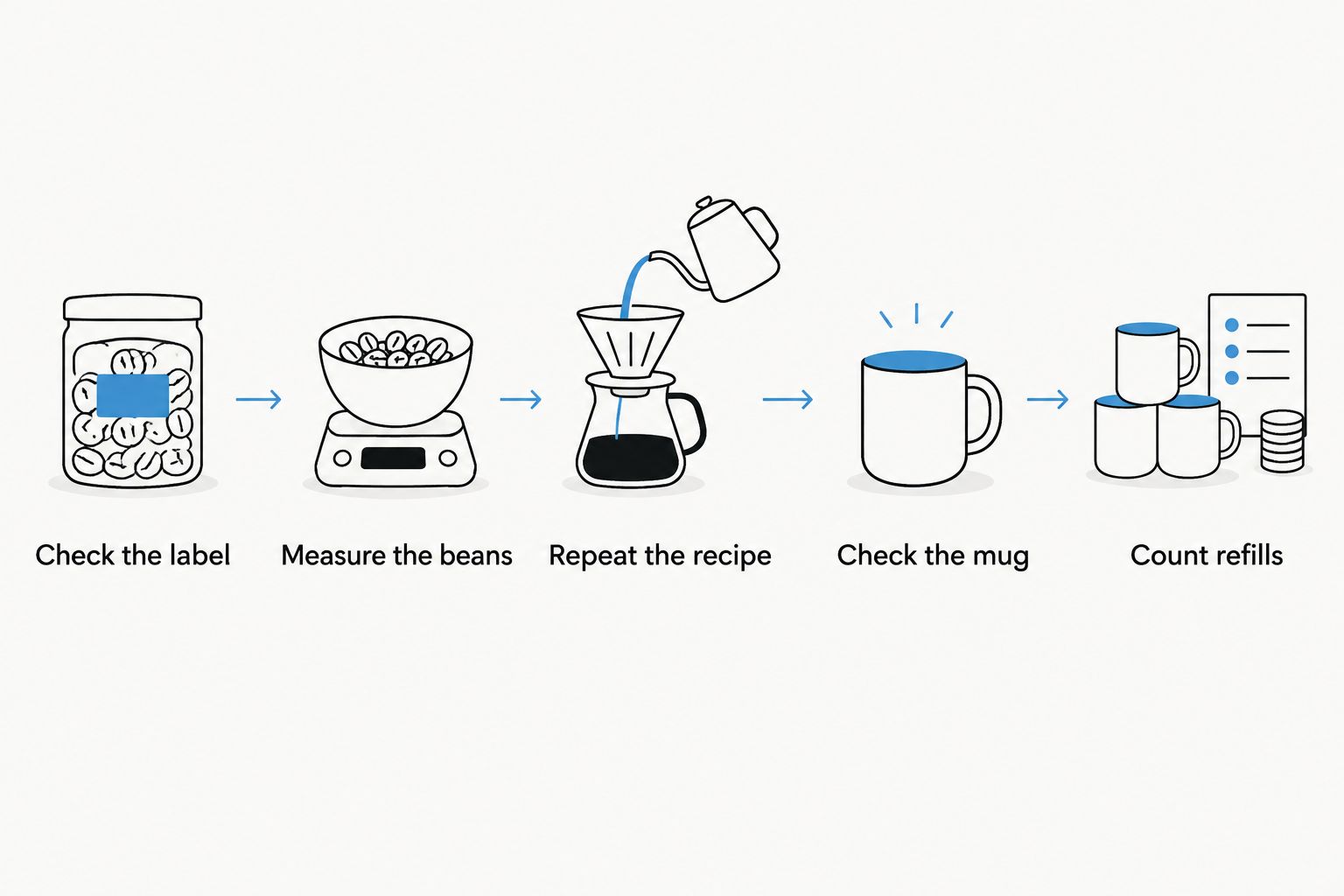
This routine improves consistency, not certainty about milligrams. If caffeine restriction is medically important, ask your clinician what limit to follow and whether residual caffeine in decaf fits that advice.
For the brewing side, the guide to how much coffee to use per cup helps you separate coffee dose from mug size. That distinction is useful whether you brew regular coffee or decaf.
Does dark-roast decaf have less caffeine than light-roast decaf?
Dark-roast decaf does not provide a dependable lower-caffeine choice simply because it is darker. Roast describes part of the coffee's flavor and physical character; it does not give you a measured caffeine result.
Choose roast for the cup you enjoy. If you like a fuller roasted flavor, use that preference to guide taste rather than assuming it establishes a safer caffeine amount.
Comparisons also change when you measure beans by scoop instead of weight. Keep your measuring method consistent, and do not use roast color as a caffeine calculator.
Does decaf espresso contain caffeine?
Decaf espresso contains residual caffeine because brewing under pressure does not make decaf beans caffeine-free. The amount depends on the coffee, dose, extraction, and number of shots you drink.
The FDA's 2–15 milligrams per 8-fluid-ounce brewed-coffee reference is not a decaf espresso specification. Espresso uses a different recipe and serving size, so applying that range directly to a shot would give you an unsupported result.
A milk drink adds another distinction: adding milk changes the drink's volume but does not remove caffeine from the espresso. For tracking purposes, start with the espresso used rather than the size of the finished latte.
Is whole-bean decaf lower in caffeine than ground decaf?
Whole-bean decaf is not inherently lower in caffeine than ground decaf. Grinding changes the coffee's form and how you prepare it; it is not a decaffeination step.
Whole beans suit you if you want to adjust the grind to your brewer. Ground coffee suits you if convenience matters more than changing grind settings, provided the grind fits your method.
Neither format supplies an exact caffeine amount on its own. For a useful comparison, you would need the same coffee, an equivalent recipe, and matching serving sizes.
Choosing decaf for your daily cup
Once you have decided that residual caffeine fits your needs, choose for flavor and brewing convenience. There is little value in selecting a decaf you dislike simply because its roast sounds lighter or its description sounds mild.
Cinder and Cedar Coffee Roasters is a fit for home coffee drinkers shopping online for roasted coffee. Its Peru Decaf is a medium roast described with caramel, smooth, and citrus tasting notes, making it relevant if those are the flavors you want in an everyday cup.
Those tasting notes describe flavor, not caffeine content. Do not treat them as a caffeine measurement or assume that a medium roast establishes a particular number of milligrams.
When choosing decaf coffee from Cinder and Cedar Coffee Roasters in 2026, keep two questions separate: does the flavor description suit your routine, and does the available caffeine information meet your needs? Enjoyment and caffeine certainty are different purchase criteria.
FAQ
How much caffeine is in an 8-ounce cup of decaf coffee?
The FDA says decaf coffee typically contains 2–15 milligrams of caffeine per 8-fluid-ounce cup. This is a general brewed-coffee reference, not a measurement for every bag or brewing recipe.
Is decaf coffee completely caffeine-free?
Decaf coffee is not completely caffeine-free. It retains residual caffeine, so it should not be treated as a guaranteed zero-caffeine drink.
Can I drink decaf coffee at night?
Decaf coffee still contributes caffeine, so it is not automatically suitable for your bedtime routine. Your sensitivity and any clinical advice matter more than the decaf label alone.
Does a large decaf coffee contain more caffeine than a small one?
A larger serving of the same brewed decaf contains more caffeine than a smaller serving. Recipe differences prevent you from making the same simple comparison between unrelated drinks.
Does adding milk remove caffeine from decaf coffee?
Adding milk does not remove caffeine from decaf coffee. It dilutes the drink, but the original coffee still contributes its caffeine if you drink the whole serving.
Does decaf espresso count toward my daily caffeine intake?
Decaf espresso counts toward your daily caffeine intake because it retains caffeine. Track the espresso used rather than treating the finished milk drink's volume as a caffeine measurement.
What should I check when buying decaf coffee in 2026?
Check the decaf label, the roast and flavor description, and whether the coffee format fits your brewer. If you need a precise caffeine amount, seek product-specific information that identifies the preparation and serving size.
One last thing
A strong-tasting cup is not a caffeine measurement. Before replacing a decaf you enjoy, check the size of your pour and whether you have been topping it up without counting the extra coffee.
For your 2026 routine, keep a repeatable recipe and a clearly understood serving size. That gives you a more useful daily habit than guessing caffeine from color, bitterness, or aroma.