

How long does cold brew coffee last in the fridge?
Plan to finish plain homemade cold brew within 7 days in the fridge, kept in a clean, covered container at 40°F or below. That is a practical recipe-based storage window, not a guarantee that every batch stays safe for a week. Added milk, interrupted refrigeration, and packaged-product instructions change the answer; this 2026 guide explains which rule to follow.
- How long does cold brew coffee last in the fridge? Plan around seven days for plain homemade coffee.
- Starbucks at Home gives a one-week refrigerated window for its cold brew recipe, not every preparation.
- Keep cold brew at 40°F or below; refrigeration does not correct poor handling.
- Add milk to your glass, not the storage batch, and follow packaged coffee’s opening instructions.
Why this matters
A batch can lose its pleasant aroma before it shows obvious spoilage. The reverse matters more: coffee that looks normal is not proof of safe handling. Treat flavor quality and food safety as separate checks.
Choosing coffee beans for cold brew helps you start with the flavor you want. Storage determines how you handle that brewed coffee afterward. A different roast or a stronger brew does not replace clean equipment, refrigeration, or a clear preparation date.
For your 2026 routine, make a batch you can finish rather than treating the longest published storage estimate as a target. Less leftover coffee is easier to manage than a large jar with an uncertain history.
How long does cold brew coffee last in the fridge?
Use a week as a planning window for plain homemade cold brew, not a universal expiration date. Starbucks at Home’s cold-brew preparation guidance gives refrigerated storage of up to a week for its recipe. That guidance applies to the prepared coffee described there, not automatically to milk drinks, bottled products, or every home recipe.
The FDA’s household refrigeration guidance sets 40°F or below as the refrigerator temperature. That temperature rule supports cold storage; it does not establish a tested shelf life for your particular batch.
| Cold brew option | Best for | Storage rule | Benefit | Limitation |
|---|---|---|---|---|
| Plain homemade cold brew | A simple make-ahead routine | Plan to finish within a week when prepared and refrigerated properly | You control the batch size | Home preparation does not have a validated commercial shelf life |
| Homemade concentrate | Adjusting strength in each glass | Follow the recipe; do not assume strength extends storage | You can dilute individual servings | A stronger flavor does not establish greater safety |
| Cold brew with milk | A drink you will serve promptly | Follow the shortest applicable ingredient or handling limit | Your drink is ready to pour | The plain-coffee storage window no longer answers the whole question |
| Packaged cold brew | Following product-specific directions | Follow refrigeration and after-opening instructions | The label gives guidance for that product | Unopened storage instructions do not automatically apply after opening |
The useful distinction is not simply homemade versus store-bought. You need to know what is in the container, when preparation or opening happened, and whether the coffee stayed refrigerated.
Plain homemade cold brew: plan for 7 days
For plain homemade cold brew, a 7-day planning window gives you a practical way to size a batch. Start with the recipe you actually follow, including its preparation and refrigeration instructions. Do not borrow a storage estimate from a different recipe while changing its handling steps.
Record both the brew-start date and the filtering date. Filtering removes grounds; it does not make previously brewed coffee new again. Keeping both dates prevents a long steep from disappearing from your record.
Taste quality is a separate reason to make less. If the aroma becomes dull or the finish turns unpleasant before you finish the jar, reduce your next batch rather than trying to stretch the current one.
A week is a planning ceiling for this routine, not a promise to keep questionable coffee. Discard a batch sooner when handling or spoilage gives you a reason.
Cold brew concentrate: strength does not set shelf life
Concentrate gives you flexibility at serving time. You can add water to one glass without diluting the entire batch, which makes it easier to adjust your daily cup.
The trade-off is that concentrate still needs the same attention to clean equipment and refrigeration. Do not give homemade concentrate an extended storage period just because it tastes stronger. Strength alone does not establish a safe holding time.
When comparing storage advice in 2026, check whether the instructions describe homemade concentrate, ready-to-drink coffee, or a commercially processed product. Those are different preparations. A bottled concentrate’s label is not evidence that your homemade version lasts equally long.
Cold brew with milk: follow the shorter applicable limit
Once you add milk or cream, you are storing a mixed drink rather than plain coffee. Follow the ingredient instructions and the drink’s handling history; do not assign it the remaining days from a plain cold-brew estimate.
The simplest routine is to keep the main batch black and add milk to your glass. You preserve flexibility, avoid mixing ingredients with different dates, and keep the storage jar separate from a drink you carry around.
FDA consumer guidance says foods requiring refrigeration should not sit at room temperature for more than 2 hours, or 1 hour when the temperature is above 90°F. Apply that handling rule to milk-containing coffee. Putting an overheld drink back in the refrigerator does not undo the time it spent warm.
Why cold brew storage time varies
The calendar alone cannot describe a batch’s condition. These factors explain why a recipe’s storage guidance needs the right handling behind it:
- Preparation method: A recipe’s storage advice belongs with its brewing, filtering, and refrigeration directions. Changing the process removes that connection.
- Refrigerator temperature: Keep the refrigerator at 40°F or below and check it with an appliance thermometer. A control dial is not a temperature measurement.
- Equipment cleanliness: Wash the brewing vessel, filter equipment, storage container, and lid before use. Old residue does not belong in a fresh batch.
- Added ingredients: Milk, cream, and other additions bring their own handling instructions. Plain-coffee guidance does not cover every mixture.
- Time outside refrigeration: Track preparation, serving, and transport rather than considering only the time the jar spends on a shelf.
- Container handling: Pour into a separate cup, close the lid, and avoid returning leftover drinks to the main batch.
Changing the beans can change aroma, body, and finish. It does not remove any of these storage requirements.
How do you store cold brew properly?
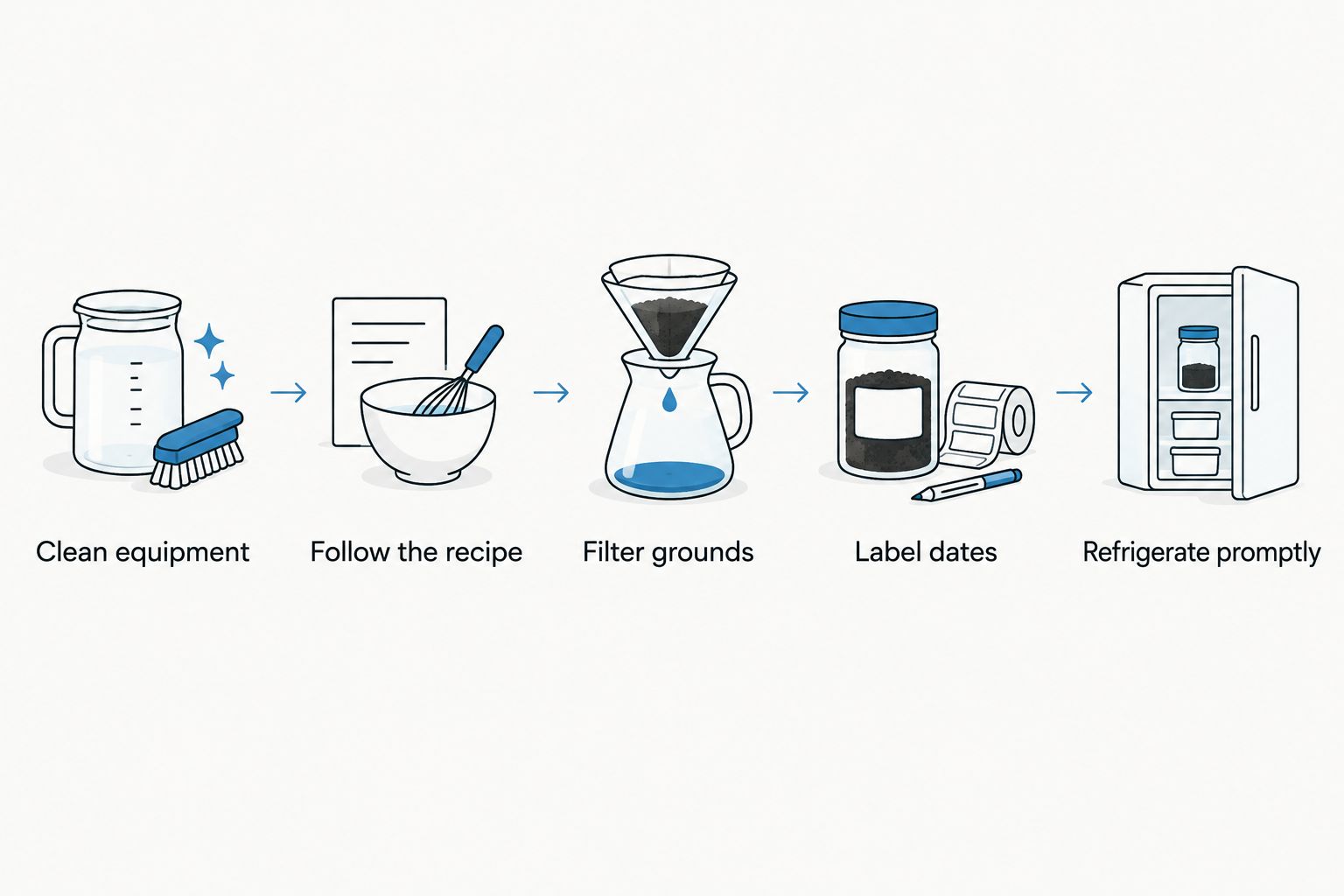
Use the same short sequence every time you prepare a batch. A repeatable process is easier to follow than deciding whether each leftover jar seems acceptable.
- Clean equipment. Wash the brewing container, storage vessel, lid, and reusable filtering equipment before preparation.
- Follow the recipe. Use its brewing and refrigeration directions rather than combining unrelated instructions.
- Filter grounds. Separate the brewed coffee from the grounds when the recipe directs you to do so.
- Label dates. Record the brew-start and filtering dates, and note any added ingredients.
- Refrigerate promptly. Keep the covered batch at 40°F or below and return it after pouring.
Choose a food-safe container with a lid that closes properly. A wide opening makes the inside easier to reach during washing; a pouring spout is useful only if you can clean it thoroughly. Keep the container closed between servings to limit exposure to refrigerator odors.
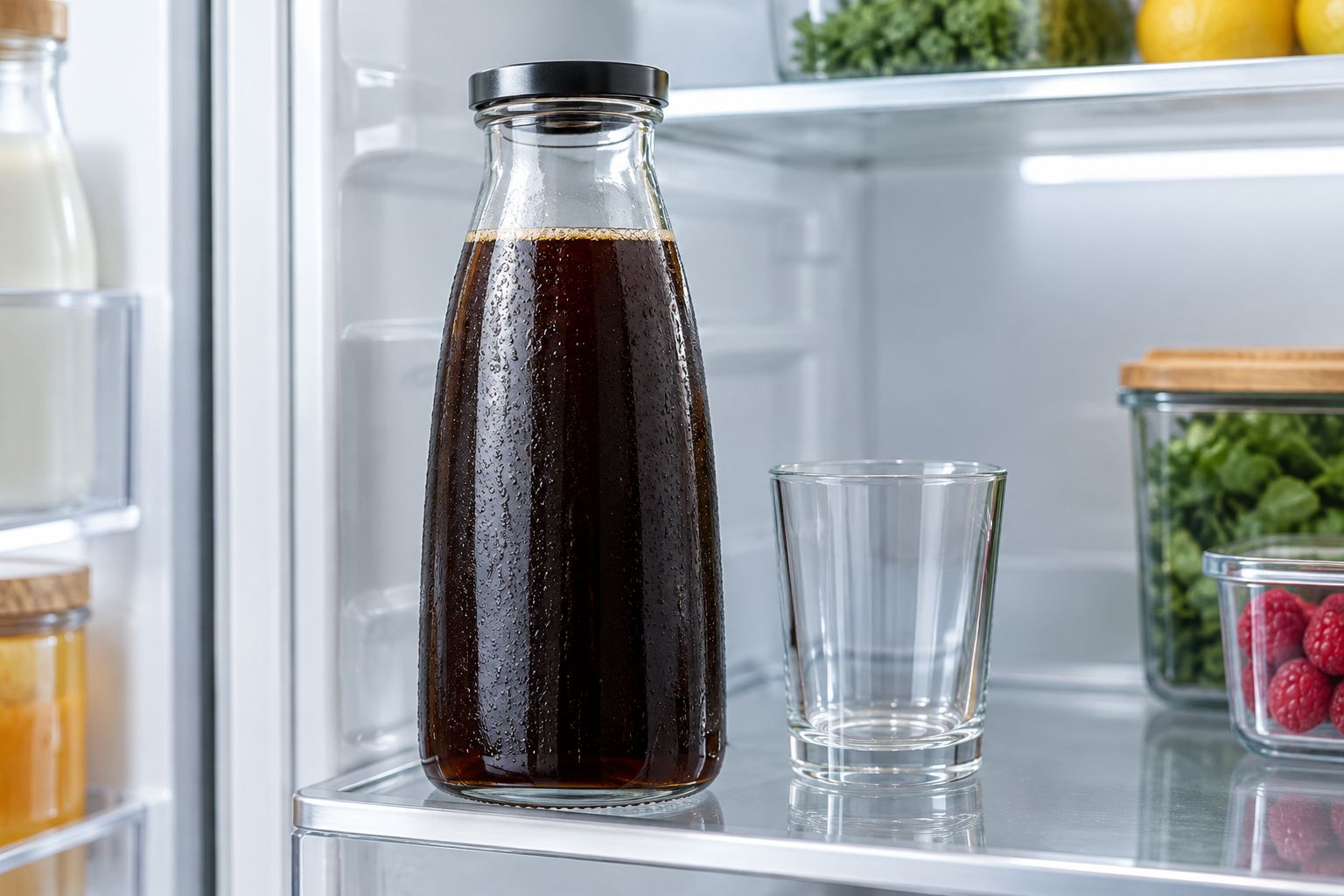
Do not top an older batch up with new coffee. Combining them obscures the older batch’s history and makes your label less useful. Finish or discard the old batch, wash the container, and then start fresh.
How can you tell when cold brew should be discarded?
Discard cold brew with visible mold, an unexpected change in texture, or an unusual odor. Unexpected bubbling in ordinary still coffee is another reason not to drink it. Do not taste a suspicious batch to find out whether it is safe.
Aroma and appearance have limits. FDA food-safety guidance explains that illness-causing bacteria do not necessarily change a food’s smell, appearance, or taste. A normal-looking jar cannot settle a question about unknown refrigeration or forgotten preparation dates.
A small amount of settled coffee material is not automatically proof of spoilage. Filtering can leave fine particles behind. But familiar sediment does not cancel another warning sign or make an uncertain storage history acceptable.
For a practical 2026 household rule, separate these decisions: discard questionable coffee, and reduce future batch size when otherwise properly handled coffee simply stops tasting good.
Does your choice of coffee change the storage rule?
Your coffee choice changes the cup you brew, not the need to refrigerate it correctly. Choose beans for the aroma, body, and finish you enjoy, then keep the same careful storage routine.
Cinder and Cedar Coffee Roasters is a fit for home coffee drinkers choosing roasted coffee for an everyday brewing routine. Its Cold Brew Coffee is explicitly described as blended for cold brewing. That gives you a relevant starting point for choosing coffee, not a separate refrigerated shelf-life claim.
The benefit of choosing a cold-brew blend is its stated brewing purpose. The limit is equally important: Cinder and Cedar Coffee Roasters’ product description does not establish how long your prepared batch lasts. Follow your recipe and handling rules regardless of which coffee you buy.
Can you drink cold brew after a week?
7 days is a planning window, not evidence that an older batch is safe. Do not extend storage because the coffee still smells normal. Follow the recipe’s limit and discard coffee with an uncertain preparation or refrigeration history.
Does adding water make old cold brew fresh again?
7 days does not restart when you dilute cold brew. Adding water changes strength, not the batch’s age or previous handling. Dilute a serving when you want to adjust flavor, not to extend storage.
FAQ
How long does homemade cold brew last in the fridge?
Plan to finish plain homemade cold brew within 7 days when prepared according to its recipe and kept covered at 40°F or below. Starbucks at Home gives a one-week refrigerated window for its recipe; this is not a safety guarantee for every homemade batch.
Does cold brew concentrate last longer than regular cold brew?
Do not assume homemade concentrate lasts longer merely because it is stronger. Follow the recipe’s storage directions, and use a packaged concentrate’s label only for that specific product.
Can I keep cold brew with milk for a week?
Do not apply a plain cold-brew storage window automatically to coffee containing milk. Follow the shortest applicable ingredient and handling limit, or add milk only when serving.
What temperature should I keep cold brew at?
Keep refrigerated cold brew at 40°F or below. FDA household refrigeration guidance uses this temperature; it does not establish a tested shelf life for your recipe.
Can I tell whether cold brew is safe by smelling it?
Smell cannot prove cold brew is safe. Discard coffee with an unusual odor, mold, or unexpected texture changes, but also consider its preparation date and refrigeration history.
Does filtering cold brew restart its storage time?
Filtering does not restart cold brew’s age. Record the brew-start and filtering dates so the preparation history stays clear.
How long does opened store-bought cold brew last?
Opened store-bought cold brew lasts for the period specified by its manufacturer’s after-opening instructions. Do not substitute a homemade recipe’s storage window or rely only on instructions for the unopened package.
One last thing
The most useful change is often a smaller batch, not a longer storage estimate. If you regularly pour away the last portion, reduce what you brew next time. Your actual drinking routine is a better batch-size guide than the capacity of your pitcher.
For your 2026 routine, choose coffee you enjoy from Cinder and Cedar Coffee Roasters, keep the storage batch plain, and label each preparation. Better organization will not extend shelf life, but it will make the next decision clearer.