

Can you make cold brew with any whole bean coffee?
Yes, you can make cold brew with any whole bean coffee intended for brewing, including light, medium, dark, flavored, and decaf coffee. Grind the beans before steeping; whole bean describes how you buy the coffee, not how you should brew it. The beans affect the flavor, while grind size, coffee-to-water ratio, and steeping time determine how the batch extracts.
- Can you make cold brew with any whole bean coffee? Yes—grind it before steeping.
- Medium roast is a practical starting point; light and dark roasts work, too.
- Use a coarse grind, measure your coffee and water, and filter the finished brew.
- Cinder and Cedar Coffee Roasters offers cold brew blends for home drinkers who want a purpose-blended option.
Can you make cold brew with any whole bean coffee?
You do not need beans labeled for cold brew. Regular roasted coffee works because cold brewing describes the preparation method, not a separate type of bean. An espresso label, single-origin label, or roast description does not prevent you from steeping that coffee in cold water.
The important distinction is between buying whole beans and brewing intact beans. Grinding exposes more coffee to water, making extraction more practical and repeatable. If you lack the equipment, read about grinding whole bean coffee without a grinder before starting.
For your 2026 home-brewing routine, choose by the flavor you enjoy rather than looking for a special certification or cold brew designation.
| Coffee option | Best for | Main advantage | Main trade-off |
|---|---|---|---|
| Medium roast | A balanced starting batch | A middle ground between lighter and darker roast flavors | Does not guarantee a particular flavor without tasting |
| Light roast | Drinkers who enjoy brighter coffee | Keeps the focus on lighter roast character | Requires careful adjustment if the result tastes sharp or thin |
| Dark roast | Drinkers who enjoy pronounced roast flavor | Brings a roast-forward character to the cup | Can taste too bitter or smoky for your preference |
| Decaf coffee | Drinkers reducing caffeine | Lets you use the same basic brewing method | Decaf does not mean caffeine-free |
| Flavored coffee | Drinkers who already enjoy added flavors | Carries the chosen flavor into a cold preparation | Added flavor can dominate the underlying coffee |
These are starting points, not promises about every bag. Roast names alone cannot tell you how your finished cold brew will taste.
Why this matters
Buying different beans before adjusting your recipe makes troubleshooting harder. A watery batch does not automatically mean the coffee is unsuitable, and a bitter batch does not prove that cold brew requires a lighter roast.
Start with coffee you already like. Keep the preparation consistent, taste the result, and change one variable before replacing the beans. That approach gives you a useful baseline instead of another partly used bag.
Your first goal is a repeatable cup, not a perfect bean choice. Once you know how your usual coffee tastes cold, comparing another roast becomes much easier.
Which roast should you choose for cold brew?
Medium roast: best for a first batch
Medium roast is a practical starting point when you do not have a strong preference for lighter or darker coffee. It gives you a useful baseline for judging strength, body, and finish without deliberately choosing either roast extreme.
The limitation is that medium roast is a broad description, not a flavor guarantee. Read the bag's tasting description, then judge the coffee in your own cup. Choose familiar flavors rather than assuming every medium roast tastes alike.
Light roast: best for lighter roast preferences
Use light roast if you already enjoy its flavor in hot coffee. Cold water does not make light-roasted beans unsuitable, but your usual hot-brew recipe does not transfer unchanged to a long, cold steep.
If the batch tastes thin or unpleasantly sharp, check the grind, ratio, and steep before rejecting the roast. Extending the steep is one adjustment; it is not a substitute for measuring the coffee correctly.
Dark roast: best for roast-forward flavor
Dark roast suits you when you enjoy a pronounced roasted character. It also gives you a clear reference point if you normally drink darker coffee with milk.
The drawback is equally straightforward: cold brewing does not remove every bitter or smoky note you dislike. If dark roast tastes too intense in your finished cup, try a less concentrated serving or choose a different roast next time.
How do you make cold brew from whole beans?
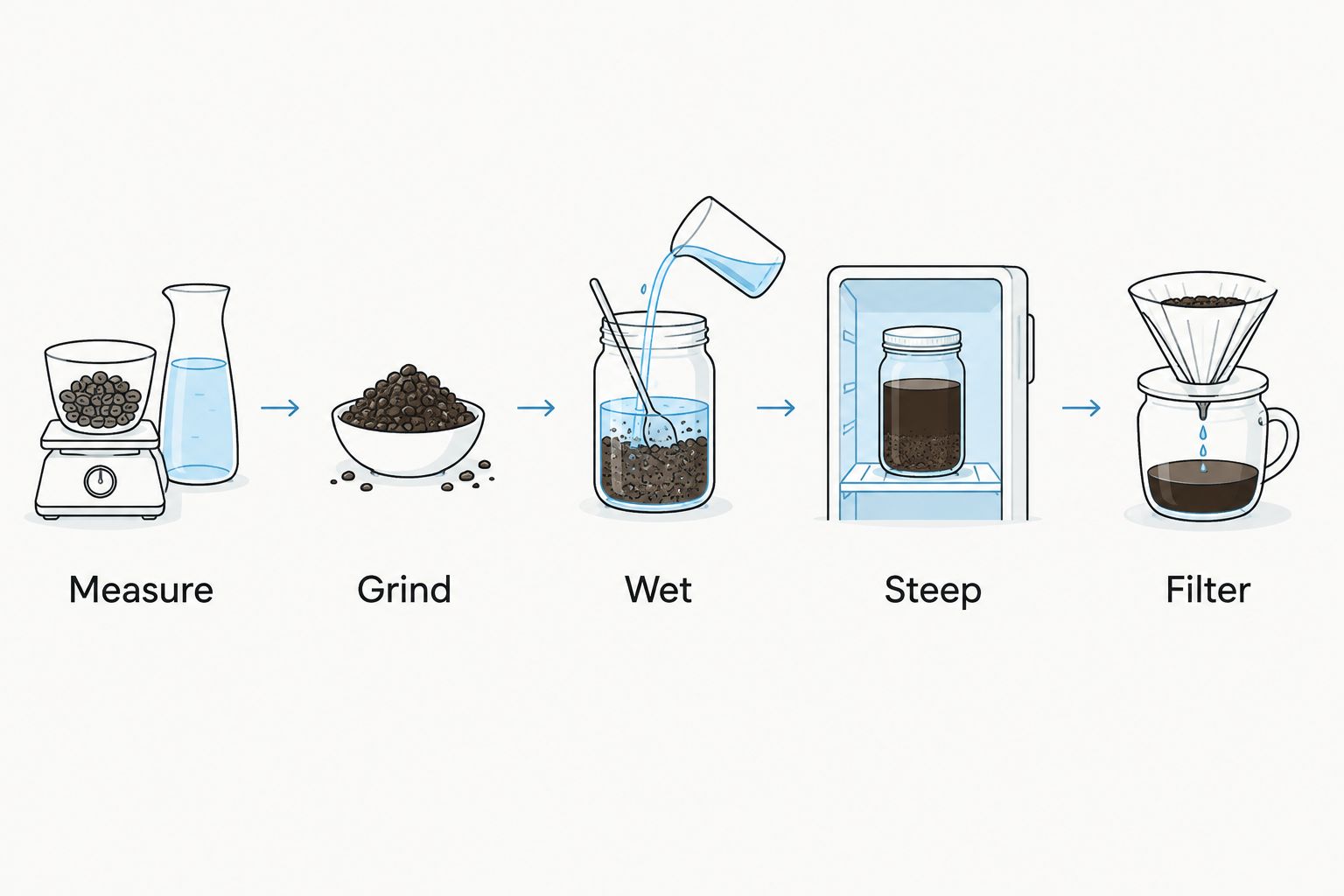
Use this as a starting recipe for a small refrigerator batch in 2026, not as a fixed rule for every coffee. Follow your brewer's directions when its filter or capacity requires a different recipe.
1. Measure the coffee and water
Start with 100 grams of coffee and 800 milliliters of water, a coffee-to-water ratio of 1:8 by weight. This is a concentrated starting recipe; taste the filtered coffee before deciding how much water or milk to add.
A scale makes the batch easier to repeat than scoops. Write down both amounts, because changing the coffee dose without recording it makes the next comparison less useful.
2. Grind the beans coarsely
Aim for visibly coarse, reasonably even grounds rather than espresso-fine powder. Coarse grounds are easier to separate from the finished brew, while fine particles can clog a filter or leave sediment.
Do not treat one grinder's setting as universal. Look at the grounds and use the grinder manufacturer's guidance for a coarse setting.
3. Wet all the grounds
Combine the ground coffee and water in a clean, food-safe container. Stir gently until the coffee is wet, checking for dry pockets rather than stirring continuously throughout the steep.
Leave enough room to mix without spilling, then cover the container. A dedicated cold brew maker is convenient, but a suitable container and separate filter can perform the same basic tasks.
4. Steep in the refrigerator
Use 12–24 hours as a common starting window for refrigerator cold brew. Record the actual steeping time so you can repeat it rather than relying on a vague overnight estimate.
Temperature affects extraction, so keep the steeping location consistent between batches. This recipe uses the refrigerator; switching between refrigerated and countertop steeping adds another variable.
5. Filter and adjust the serving
Separate the grounds from the liquid. Use your brewer's filter or strain the coffee, then pass it through a suitable paper filter if you want a cleaner cup with less fine sediment.
Taste a small serving before adding ice or milk. If the brew is too strong, dilute that serving gradually and record what tastes right. Keep the remaining batch covered and refrigerated.
Why cold brew flavor varies
The same beans can produce different results when your preparation changes. For a useful 2026 recipe record, note these factors alongside your tasting comments:
- Roast and coffee choice: The starting coffee supplies the flavor. Cold brewing does not make every roast taste identical.
- Grind size: Finer particles extract differently and are harder to filter cleanly. Keep the grind consistent while testing another variable.
- Coffee-to-water ratio: More coffee relative to water produces a more concentrated preparation. Measure instead of guessing.
- Steeping time and temperature: Extraction changes with both. Record where the coffee steeped as well as when you filtered it.
- Filtration and serving: Sediment affects texture, while water, milk, and melting ice change the strength you actually drink.
Change one variable per batch. If you replace the beans, grind finer, steep longer, and dilute differently, you cannot identify which change improved the cup.
Do you need a dedicated cold brew blend?
No. A purpose-blended coffee is an option, not a requirement for successful cold brewing. Regular beans remain a sensible choice when you already enjoy their flavor and want to use one bag for several brewing methods.
Cinder and Cedar Coffee Roasters cold brew blends are best for home drinkers who want coffee specifically described for cold brewing. The store lists two products titled Cold Brew Coffee: one is described as specifically blended for cold brew, while the other lists a medium profile with chocolate, toffee, and floral tones and suitability for cold brew or nitro.
The benefit is a clearly stated intended use. The limitation is that a purpose-blended coffee still needs the right grind, measured water, and a serving strength you enjoy; its label cannot correct an inconsistent recipe.


Can you use espresso beans for cold brew?
Yes, espresso-labeled beans work for cold brew because the label does not restrict the brewing method. Buy the beans for their flavor, then grind them for cold brewing rather than using an espresso-fine setting.
The same distinction applies when you choose Cinder and Cedar Coffee Roasters coffee for different home brewing routines: the coffee choice and the grind choice are separate decisions. Check the bag's format before brewing.
Can you steep whole coffee beans without grinding them?
Intact roasted beans can release flavor into water, but they are not a direct substitute for ground coffee in a standard cold brew recipe. Grinding exposes more surface area, so the recipe above assumes you have ground the beans first.
For a repeatable home batch in 2026, grind before steeping. Do not extend a ground-coffee recipe arbitrarily and expect intact beans to produce the same result.
What should you change if cold brew tastes wrong?
Taste the coffee before adding milk or sweetener so you can identify the problem. Then make a targeted adjustment rather than changing the entire recipe.
| What you notice | What to check first | Next move |
|---|---|---|
| Too weak after serving | Added water, milk, and melting ice | Taste the undiluted coffee before changing the next batch |
| Thin before dilution | Coffee dose, grind, and steep | Verify your measurements, then test one adjustment |
| Too intense | Serving concentration | Dilute a small portion gradually |
| Bitter or smoky | Roast preference and extraction | Compare a shorter steep or a different roast separately |
| Gritty or muddy | Fine particles and filtration | Improve filtration before replacing the beans |
A thin cup and a diluted cup are not necessarily the same problem. Check what happened between filtering and drinking before blaming the steep.
FAQ
Can you make cold brew with any whole bean coffee?
Yes, you can make cold brew with any roasted whole bean coffee intended for brewing. Grind the beans first and adjust the recipe to your taste.
What's the best roast for my first cold brew batch?
Medium roast is a practical starting point if you do not already prefer light or dark roast. Your existing flavor preference matters more than a cold brew label.
How much coffee should I use for homemade cold brew?
Start with 100 grams of coffee and 800 milliliters of water for a concentrated test batch. Taste after filtering and dilute your serving as needed.
How long should I steep cold brew in the refrigerator?
Use 12–24 hours as a common starting window for refrigerator cold brew. Record the actual time and adjust one variable at a time.
Can I use regular preground coffee for cold brew?
Yes, regular preground coffee works, but a finer grind can leave more sediment and make filtering harder. Use a suitable filter and judge the result before repeating the recipe.
Can I make cold brew with decaf beans?
Yes, decaf beans work with the same basic cold brewing method. Decaf coffee still contains some caffeine.
Do I need a special cold brew coffee maker?
No, a clean food-safe container and a suitable filter can handle the basic process. A dedicated brewer mainly changes how you steep and separate the grounds.
One last thing
Save a little undiluted coffee before you finish each batch. Taste it beside your usual serving with water, milk, or ice. That comparison separates a brewing problem from a serving-strength problem without using another bag.
For your next 2026 batch, record the beans, grind, measured ratio, steep, and final dilution. A short recipe note is more useful than remembering only that yesterday's cold brew tasted better.