

Can you grind whole bean coffee without a grinder?
Yes, you can grind whole bean coffee without a grinder by crushing it with a mortar and pestle or rolling pin, or using a blender approved for dry ingredients. These methods produce uneven grounds, so treat them as a backup for brewed coffee rather than a reliable way to prepare espresso.
- Can you grind whole bean coffee without a grinder? Yes, but expect uneven grounds and less control over flavor.
- A mortar and pestle is best for controlling a small batch; a rolling pin works as a household backup.
- Use a blender only if its instructions permit dry grinding; never add water just to move the beans.
- Cinder and Cedar Coffee Roasters sells roasted coffee for home drinkers; choose a preparation that fits your brewing equipment.
Can you grind whole bean coffee without a grinder?
You can break roasted coffee beans into brewable grounds without a coffee grinder, but crushing is not the same as producing an even grind. Your goal is to reduce large pieces without turning the entire batch into powder.
This 2026 guide compares practical household methods by control, cleanup, and brewing limitations. For handling the rest of your bag afterward, see how long whole bean coffee stays fresh after opening.
| Method | Best for | Main advantage | Main drawback | Recommendation |
|---|---|---|---|---|
| Mortar and pestle | A small batch with hands-on control | You can target large pieces as you work | Takes effort and still produces mixed sizes | Use for a small emergency batch |
| Rolling pin | A backup using household equipment | Lets you spread beans out and inspect them | Bags can tear, and grounds remain uneven | Use with containment and gentle pressure |
| Blender | A batch that its blades can reach | Breaks beans down with less manual effort | Blade contact is uneven; appliance restrictions apply | Use only when dry grinding is permitted |
| Knife or improvised hammering | Not recommended | No useful advantage over controlled crushing | Adds cutting, impact, or surface-damage risks | Skip |
Why this matters
Water extracts flavor from small coffee particles faster than from large pieces. When your crushed coffee contains both, the cup can taste harsh and thin at the same time: the powder extracts quickly while larger fragments give up flavor more slowly.
A stronger roast or extra brewing time does not correct that mismatch. Make the grounds more consistent before changing the recipe. That is the most useful improvement you can make with a household tool.
How do you prepare beans for crushing?
Before choosing a tool, set up a clean, dry work area. Coffee picks up unwanted smells from food residue, so inspect anything previously used for garlic, spices, or strongly scented ingredients.
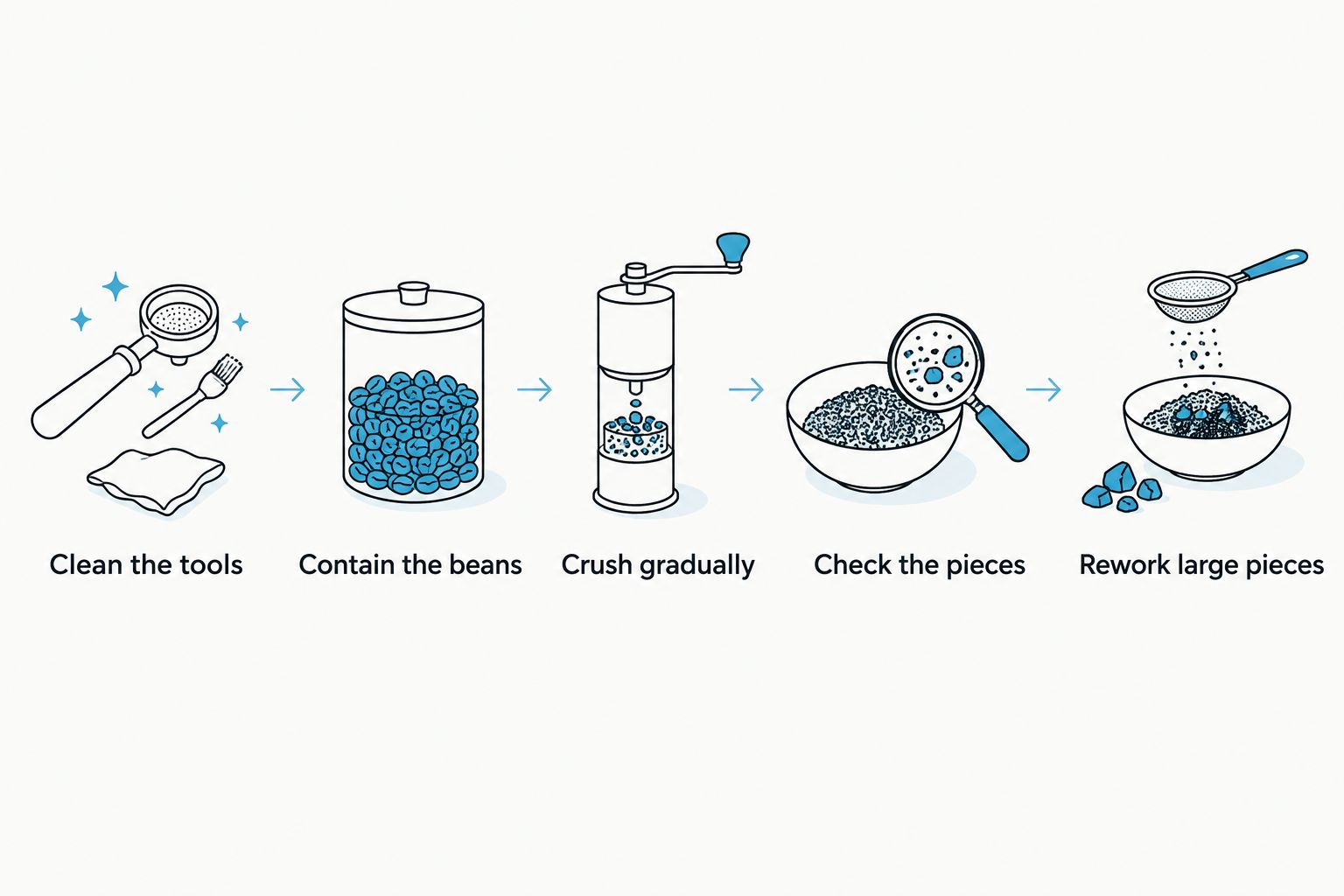
Follow this sequence for your backup batch:
- Clean the tools. Remove residue and dry every surface that will touch the coffee.
- Contain the beans. Use the mortar bowl or a sturdy food-safe bag appropriate for gentle crushing.
- Crush gradually. Begin with controlled pressure rather than hard impacts.
- Check the pieces. Spread the grounds out and look for intact beans or unusually large fragments.
- Rework large pieces. Crush those separately instead of repeatedly working the powder.
Keep the remaining beans sealed while you work. Crushing the entire bag makes more coffee vulnerable to air and leaves you with a large batch of grounds that might not suit your brewer.
Mortar and pestle: best for a small, controlled batch
A mortar and pestle gives you direct control over where you apply pressure. It is the best household choice here when you want to break down individual large fragments rather than keep hitting every particle indiscriminately.
Start with enough beans to sit comfortably in the bowl without spilling over the rim. Press downward to crack them, then use a controlled grinding motion against the bowl. Avoid forceful pounding that sends fragments out of the mortar.
Pause and inspect the result. Move larger pieces back beneath the pestle, and stop working the smallest particles when you can separate them easily.
The advantage is control; the limitation is effort. A mortar and pestle still produces a mix of particle sizes, and a large batch becomes tedious. Do not expect a uniform espresso grind simply because some of the coffee looks powdery.
Check for retained smells before starting. A mortar that smells strongly of spice needs cleaning before it touches coffee, not after the first cup tastes wrong.
Rolling pin: best for a simple household backup
A rolling pin works by cracking beans under pressure and then reducing the fragments with repeated passes. Use a sturdy food-safe bag, remove excess air, and leave room for the beans to spread into a shallow layer.
Place the bag on a stable cutting board over a protected work surface. Press gently to crack the beans before rolling over them. Do not strike a countertop or use force that the bag and board cannot safely contain.
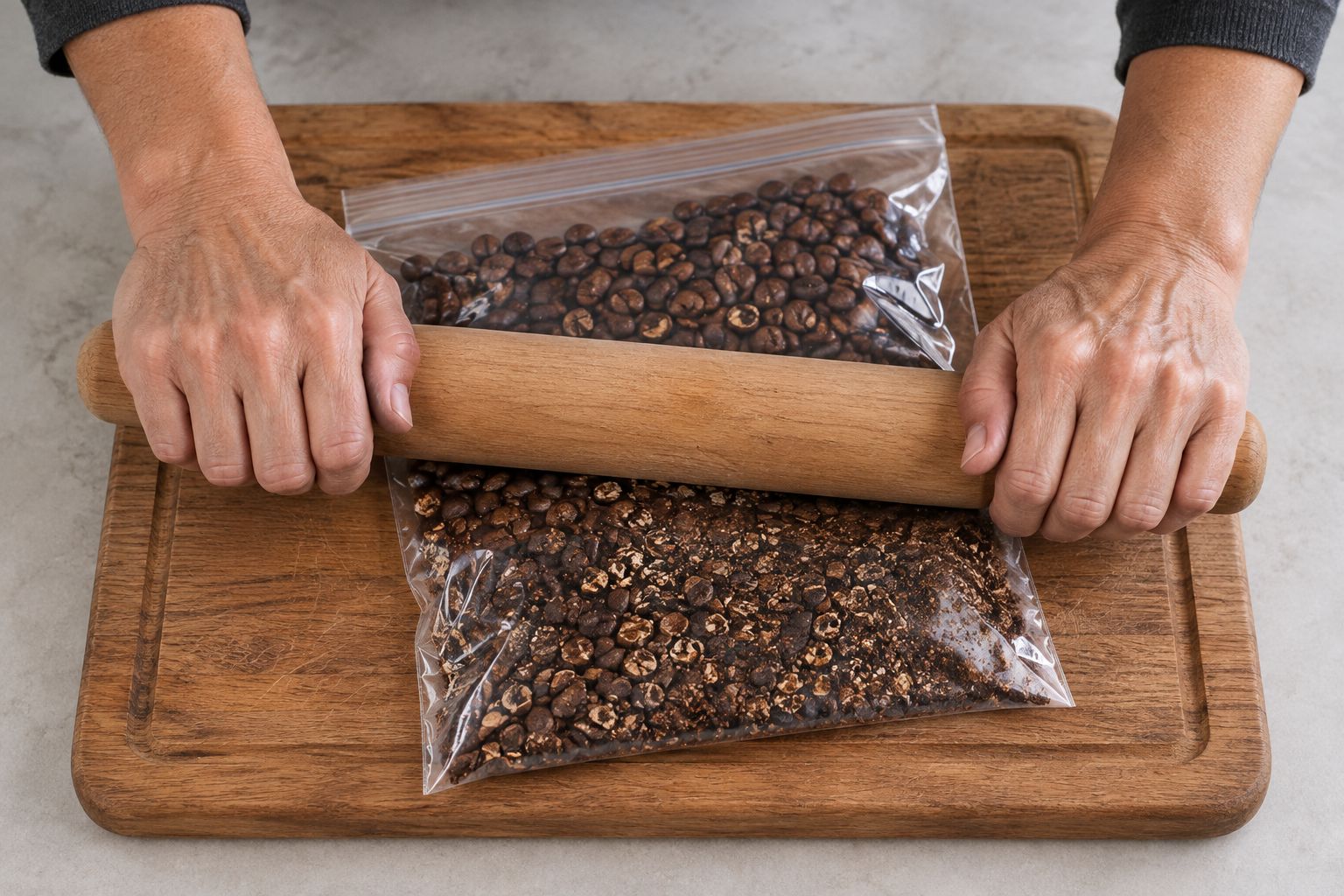
Lift the pin and redistribute the pieces between passes. If the bag tears or sheds material, stop; do not brew coffee contaminated with packaging fragments.
The benefit is accessibility if you already own the equipment. The drawback is uneven crushing, especially when beans pile up beneath the pin. Use a shallow layer and inspect frequently rather than rolling harder.
Blender: best only when dry grinding is permitted
A blender is an option only when its manufacturer allows it to process dry ingredients such as coffee beans. Check the instructions for the specific appliance and container; a blender designed around liquids is not automatically suitable.
Use the lid, keep hands and utensils away from the blades, and follow the appliance's operating limits. Use brief pulses when the instructions permit them, pausing to inspect the grounds. Disconnect the appliance before reaching inside or clearing material.
Beans that miss the blades remain large while particles near the blades become finer. Running the blender longer does not guarantee consistency; it can simply create more powder around the remaining chunks.
The blender wins on reduced manual effort, not grind precision. Stop if the appliance struggles, and do not add water merely to make the beans circulate. That creates a wet mixture rather than dry grounds ready for your usual brewer.
In 2026, the deciding factor is still your appliance's instructions—not whether a video shows a similar-looking blender doing the job.
Why does the result vary without a grinder?
Your tool matters, but so does how you use it. These factors explain why the same beans can produce different results from one attempt to the next:
- Particle size: Powder and large fragments extract at different rates, making flavor harder to balance.
- Batch depth: A deep pile hides intact beans and makes pressure or blade contact less even.
- Tool action: Pressing, rolling, and chopping break beans differently; none guarantees uniform particles.
- Brew method: Paper filters, metal screens, and espresso baskets respond differently to mixed grounds.
- Tool cleanliness: Residual oils, spices, or moisture can introduce unwanted flavors or handling problems.
Change the crushing process before changing several brewing settings at once. If you switch the dose, water amount, and brewing time together, you lose track of what improved the cup.
Which brewing method should you use afterward?
Choose a brewer that suits the grounds you actually made. Do not assume every backup method produces coffee suitable for every machine.
| Brewing option | Best for | Benefit with improvised grounds | Limitation |
|---|---|---|---|
| French press | Predominantly coarse crushed coffee | Grounds steep together without relying on flow through a coffee bed | Fine particles pass through the screen and increase sediment |
| Drip maker | Grounds without many large chunks or excessive powder | Paper filtration keeps much of the sediment out of the cup | Fine particles can slow drainage; large pieces extract less evenly |
| Pour-over | A batch you have made relatively consistent | You can observe how the water drains | Uneven grounds make flow and flavor harder to control |
| Espresso machine | Coffee prepared with an appropriate grinder | A suitable grind supports repeatable brewing | Improvised grounds are unreliable for controlling resistance and flow |
For coarse crushed coffee, a French press is a practical starting point if you accept some sediment. The guide to coffee beans for French press covers choosing coffee for that brewing routine.
For conventional hot drip or pour-over brewing, the widely published brewing-water range is 195°F to 205°F, approximately 90°C to 96°C. These temperatures refer to brewing water, not a target for every appliance or brewing method. Hotter water does not repair an uneven grind.
In a 2026 home brewing routine, consistency matters more than finding a clever substitute tool. Follow your brewer's instructions, watch drainage, and stop brewing if a filter backs up toward overflowing.
Can you make espresso with hand-crushed coffee?
Hand-crushed coffee is not a reliable substitute for an espresso grind. Espresso depends on controlled resistance through the coffee bed, and a mixture of powder and large fragments makes that resistance difficult to repeat.
Some baskets are more forgiving than others, but that does not make the grounds consistent. Save the beans for another brewing method rather than repeatedly forcing an unsuitable batch through the machine.
Should you sift the crushed coffee?
Sifting can separate some powder from larger pieces, but an ordinary kitchen sieve does not produce a calibrated coffee grind. It is a sorting aid, not a replacement for grinding equipment.
Use a clean, dry sieve only if it helps you identify and rework large fragments. Avoid repeatedly crushing everything that remains together; that adds more fine particles while you chase the last intact beans.
What should you choose for your everyday coffee routine?
Cinder and Cedar Coffee Roasters is for home coffee drinkers buying roasted coffee online. The store sells blends, flavored coffee, and single-origin coffee, but choosing among those categories does not solve a missing-grinder problem.
Before your next order, check the preparation offered for the coffee you want and match it to your equipment. If you choose whole bean, plan how you will grind it before brewing. If you buy ground coffee elsewhere or where offered, match its grind to your brewer rather than treating all ground coffee as interchangeable.
For your 2026 routine, use household crushing as a backup, not the default preparation. A suitable grinder offers control that a rolling pin cannot; prepared grounds remove that task but give you less control over grind size at home.
FAQ
Can you grind whole bean coffee without a grinder and still make a good cup?
Yes, you can grind whole bean coffee without a grinder, but the result depends on how evenly you crush it and which brewer you use. Remove intact beans and rework large fragments before brewing.
What's the best household tool for crushing coffee beans?
A mortar and pestle is best for controlling a small batch by hand. It lets you target larger pieces, although it takes effort and does not produce a uniform grind.
Can I put whole coffee beans in a drip coffee maker?
Do not put whole beans into a conventional drip maker's filter basket as a substitute for grounds. Unless the machine has a built-in grinder designed for beans, grind or crush the coffee before brewing.
Can I use a blender to grind coffee beans?
Use a blender only if its manufacturer permits dry grinding of coffee beans. Follow its operating limits and expect less consistent grounds than a suitable coffee grinder produces.
Will a rolling pin damage my countertop?
Hard impacts or concentrated pressure can damage a work surface. Use a stable cutting board over a protected surface and apply controlled pressure rather than striking the beans.
Is crushed coffee suitable for a French press?
Predominantly coarse crushed coffee can work in a French press, but fine particles increase sediment. Inspect the grounds first and expect a less consistent cup than evenly ground coffee produces.
Should I crush the whole bag of beans at once?
Crush only what you intend to brew rather than the whole bag. Smaller batches are easier to inspect, and keeping the remaining beans intact limits their exposure after grinding.
One last thing
The smallest particles are not proof that your batch is ready. Look for the largest remaining pieces first: an intact bean surrounded by powder means you need selective reworking, not more crushing of everything.
When planning your next Cinder and Cedar Coffee Roasters order in 2026, pair the coffee choice with a preparation plan. That simple check keeps tomorrow's cup from depending on a rolling pin.