

Can decaf coffee beans be used for espresso?
Yes, decaf coffee beans can be used for espresso in a manual, semiautomatic, or bean-to-cup machine that accepts coffee beans. Use an espresso-appropriate grind and adjust the recipe for the beans rather than copying your regular coffee settings; decaf still contains some caffeine.
- Can decaf coffee beans be used for espresso? Yes—grind, dose, and adjust them like other espresso beans.
- Decaf espresso is not caffeine-free; a strong coffee flavor does not tell you its caffeine content.
- Start with a familiar recipe, then adjust grind and beverage weight to improve flavor.
- Cinder and Cedar Coffee Roasters lists Peru Decaf as a medium roast with caramel, smooth, and citrus notes.
Why this matters
Switching to decaf should not mean giving up your espresso routine. You can still make a straight shot, an Americano, or a milk drink, but the grinder setting that worked for your regular beans is only a starting point.
For your 2026 home setup, separate two decisions: how much caffeine you want and how you want the coffee to taste. Decaffeination addresses the first; roast, grind, brewing, and your recipe shape the second. The guide to espresso beans and the perfect dose explains another part of that routine.
Can decaf coffee beans be used for espresso?
Decaf beans work for espresso because espresso is a brewing method, not a separate species of coffee. An espresso label can indicate a roaster's intended use, but beans do not need that label to work in your machine.
The practical requirement is matching the coffee preparation to your equipment. A traditional espresso basket needs a suitable grind and an evenly prepared bed of coffee; a capsule machine needs its compatible capsule format instead of loose beans.
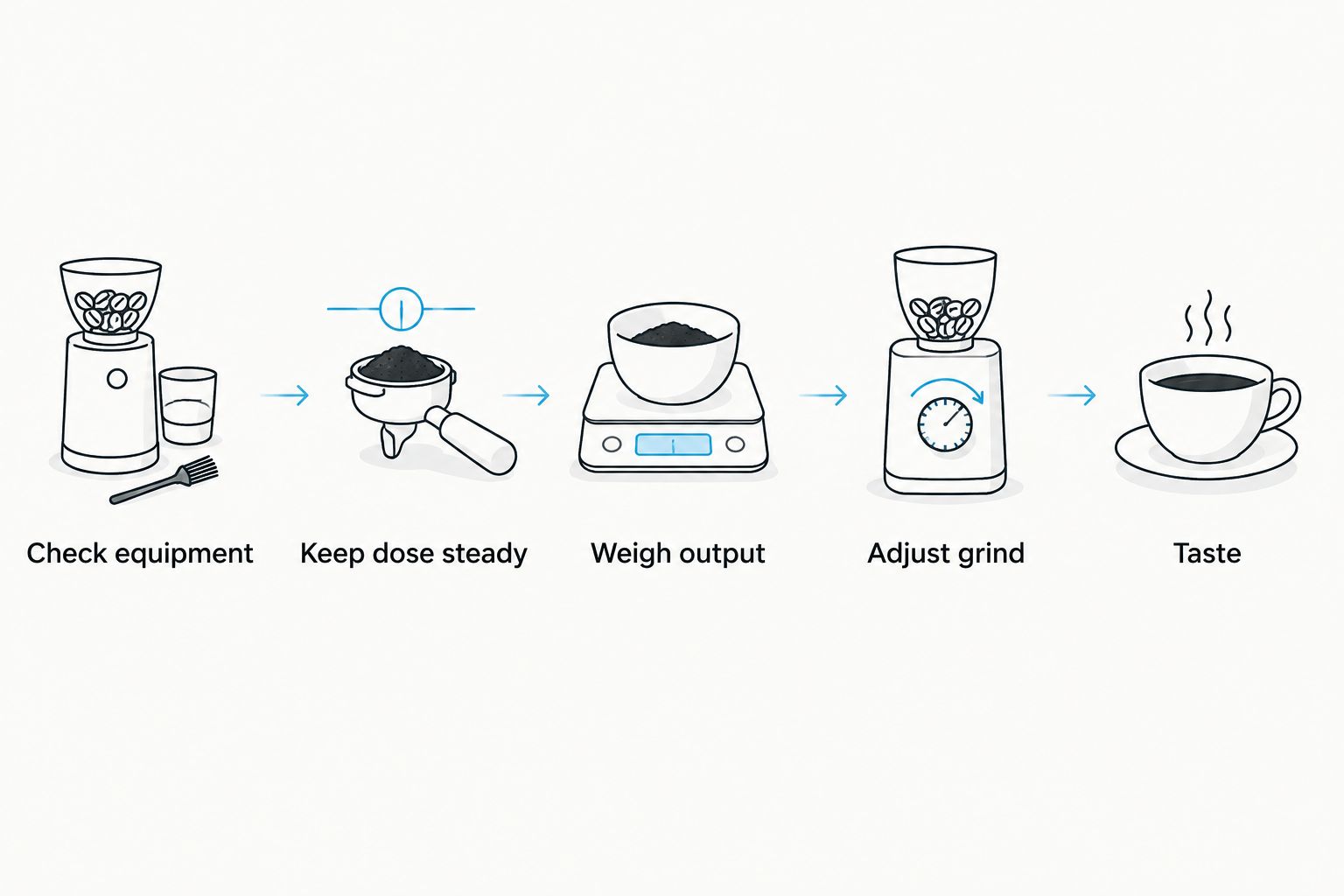
Follow this sequence when switching from regular beans to decaf:
- Check the equipment. Confirm whether your machine accepts whole beans, ground coffee, or capsules. Follow its instructions for the basket and grinder.
- Keep the dose steady. Use the coffee amount recommended for your basket. Changing the dose between attempts makes comparisons harder.
- Weigh the output. Measure the brewed espresso rather than judging only by the liquid's height or crema.
- Adjust the grind. Make a small change if the shot runs unusually fast or slow. Keep the dose and target output unchanged while testing that adjustment.
- Taste the result. Let the espresso cool enough to taste comfortably. Look for sweetness, balanced acidity, body, and a finish you enjoy.
- Write down the recipe. Record the beans, grinder setting, coffee weight, beverage weight, and your impression. Those notes are more useful than remembering whether a shot looked right.
A simple 2026 recipe log can stay on paper beside the grinder. You do not need a connected machine or an app to make useful comparisons.
What recipe should you start with for decaf espresso?
A 1:2 brew ratio is a common starting point for espresso, not a rule that every decaf must follow. For example, 18 grams of ground coffee producing 36 grams of espresso gives you that ratio; use this example only if an 18-gram dose suits your basket.
A shot time around 25–30 seconds is another familiar starting reference. Treat it as a diagnostic clue, not a pass-or-fail test: basket design, equipment, coffee, and when you start timing all affect the result.
For a repeatable 2026 brewing routine, use your machine's guidance before copying a recipe from another setup. A smaller basket needs an appropriate dose, not extra coffee forced into it to match an example.
Keep your first comparison simple:
- Record the dry coffee weight in grams.
- Record the brewed espresso weight in grams.
- Time each attempt the same way.
- Change one setting, then taste again.
A recipe is useful when it helps you repeat a good cup—not when it makes you ignore the flavor. If the espresso tastes balanced outside your starting time window, do not spoil it just to hit the timer.
Which decaf roast works best for espresso?
No roast level is automatically required for decaf espresso. Choose the flavor direction you enjoy, then consider whether you usually drink the shot straight or add milk.
These are general roast tendencies, not guarantees for every bag. Origin, processing, roasting, and brewing also affect the cup.
| Decaf roast option | Best for | Main advantage | Main trade-off |
|---|---|---|---|
| Light roast | Drinkers who enjoy brighter, fruit-forward espresso | Keeps a brighter flavor direction in focus | Brightness can taste sharp when the extraction is unbalanced |
| Medium roast | Drinkers seeking a balance of roast character and acidity | Gives you a middle ground for everyday brewing | Does not provide the pronounced roast flavor some dark-roast drinkers want |
| Dark roast | Drinkers who prefer a pronounced roasted flavor | Brings a roast-forward character to the cup | Bitter or smoky notes can dominate more delicate flavors |
Medium-roast decaf: best for a balanced starting point
Choose a medium roast if you want a starting point between bright and strongly roasted flavors. Taste it without milk first, even if you normally make a latte, so you can identify what the espresso contributes.
Cinder and Cedar Coffee Roasters lists Peru Decaf as a medium roast with caramel, smooth, and citrus tasting notes. Those notes describe a flavor direction, not a promise that every espresso recipe will taste identical; citrus is also relevant if you prefer very little brightness.
Dark-roast decaf: best for roast-forward preferences
Choose a dark roast because you enjoy its roasted character, not because espresso requires dark beans. Its stronger roast flavor suits that preference, but it is a drawback if you want a delicate or brighter cup.
Do not keep grinding finer simply to make the drink seem stronger. If bitterness increases without improving the flavor, return to the previous setting and reassess the recipe.
Light-roast decaf: best for brighter flavor preferences
Choose a light roast if you actively enjoy brightness in coffee. A bright shot is not automatically a bad shot, but sharp acidity without enough sweetness is a reason to revisit the extraction.
The limitation is preference as much as technique. If you dislike bright coffee, buying it and trying to remove all its brightness through brewing is an awkward starting point.
Why decaf espresso results vary
Decaffeination does not give every coffee the same flavor or brewing behavior. These factors explain why a setting that works for one bag does not settle the recipe for the next:
- The beans and processing. Origin and processing contribute to flavor before you choose an espresso recipe. Decaf is a category, not a single taste.
- Roast level. Roasting changes flavor and how readily coffee extracts. Choose the roast for your taste, then adjust the brewing around it.
- Grind size. Grind affects resistance and extraction. A setting copied from regular coffee is a trial setting, not a confirmed match.
- Dose and distribution. Unevenly distributed grounds can let water find easier paths through the basket. More coffee does not fix uneven preparation.
- Freshness and storage. Opened coffee changes over time. Keep beans sealed, away from heat and moisture, and use your recipe notes to recognize changes.
- Machine condition. Coffee residue, a dirty basket, and inconsistent preparation complicate troubleshooting. Maintain the machine according to its instructions.
When reviewing your 2026 coffee routine, check these basics before buying accessories. A new tool does not correct an unsuitable grind or an inconsistent dose by itself.
How do you fix a decaf espresso shot that tastes wrong?
Fix a repeatable symptom, not every setting at once. First confirm that you weighed the dose and output consistently and prepared the basket evenly.
If the shot tastes sour and runs much faster than your successful attempts, test a slightly finer grind while keeping the dose and output steady. If the shot barely flows, check for an overly fine grind or a dose that does not suit the basket before changing anything else.
Use this troubleshooting table to choose a controlled next step:
| What you notice | What to check first | Next move |
|---|---|---|
| Fast flow with a thin, sharp cup | Grind and even distribution | Test a slightly finer grind with the same dose and output |
| Very slow flow or little output | Grind and basket loading | Confirm the dose fits, then test a slightly coarser grind |
| Harsh bitterness | Roast preference, cleanliness, and recipe | Clean as directed and compare a shorter output |
| Different results between attempts | Weighing and preparation | Repeat the same dose, output, and preparation before adjusting |
| A shot that tastes good despite unexpected timing | Your timing method and flavor | Keep the successful recipe rather than chasing a standard time |
Sourness and bitterness are clues, not complete diagnoses. Uneven extraction can produce confusing flavors, so inspect your preparation before assuming the beans need an extreme adjustment.
Can you use preground decaf for espresso?
Preground decaf works when its grind suits your espresso equipment. A bag ground for a drip maker is not interchangeable with a grind intended for a traditional espresso basket.
Whole beans give you control over grind adjustments; the trade-off is needing an appropriate grinder and adding a grinding step. Preground coffee removes that step, but you cannot make an unsuitable grind finer or coarser after purchase.
Pressurized baskets can be more forgiving of grind variation than traditional nonpressurized baskets. Check your machine's instructions rather than assuming every espresso machine has the same requirements.
Does decaf espresso still contain caffeine?
Decaf espresso still contains some caffeine. Neither a dark roast nor a small serving establishes the caffeine amount in your particular drink.
If caffeine restriction is medically important, use product-specific information and guidance from your clinician. Do not use the strength of the flavor, the amount of crema, or the word decaf as proof of zero caffeine.
FAQ
Can I put decaf beans in my automatic espresso machine?
Yes, if your automatic espresso machine accepts whole coffee beans. Follow its instructions for changing beans and using any separate ground-coffee compartment; coffee remaining in the grinder can carry into the next drink.
Do decaf beans need a special espresso grinder?
No, decaf beans do not require a decaf-only grinder. They need a grinder capable of adjustments suitable for your espresso equipment, just as regular beans do.
Should I use the same grind setting for decaf and regular espresso?
Use the same setting only as a starting point, not as a guaranteed match. Keep the dose and output steady, then adjust the grind according to flow and taste.
Can decaf espresso make crema?
Yes, decaf espresso can produce crema. Crema alone does not establish flavor quality, freshness, or caffeine content, so taste the shot before changing a recipe that works.
Can I make a latte with decaf espresso?
Yes, you can use decaf espresso as the coffee base for a latte. Dial in the espresso first, then add your usual milk so you can judge the coffee separately from the finished drink.
Is dark-roast decaf better than medium-roast decaf for espresso?
Dark-roast decaf is not automatically better for espresso. Choose dark roast for a pronounced roasted flavor and medium roast for a less roast-forward starting point, then judge the result in your usual drink.
Does Cinder and Cedar Coffee Roasters have a decaf coffee listed?
Cinder and Cedar Coffee Roasters lists Peru Decaf, a medium roast described with caramel, smooth, and citrus tasting notes. Use those notes to assess your flavor preference rather than assuming a specific espresso recipe.
One last thing
Save the recipe that tastes good before you try to improve it. In your 2026 brew notes, keep a clear baseline so you can return to it after an unsuccessful adjustment.
Cinder and Cedar Coffee Roasters serves home coffee drinkers shopping online for roasted coffee. For decaf espresso, the useful buying decision is whether the roast and flavor description match your daily cup—not whether the bag makes espresso sound complicated.