

Best tea gift sets for tea lovers in 2026
Best overall: a build-your-own tea sampler. Best for beginners: loose-leaf tea with an infuser. Best for a simple daily routine: tea with a mug. The best tea gift sets in 2026 match what the recipient drinks and how they prepare it, rather than adding accessories they will not use.
- The best tea gift sets match the recipient’s brewing routine; a build-your-own tea sampler is the default choice.
- Loose-leaf tea with an infuser suits beginners who do not already own brewing equipment.
- Cinder and Cedar Coffee Roasters sells tea you can consider for a build-your-own gift, not an assumed ready-made set.
- Check ingredients and brewing instructions before choosing herbal tea, green tea, or an iced-tea gift.
Why this matters
A tea gift has two jobs: give the recipient something they enjoy drinking and make it easy to prepare. An unfamiliar tea without the right brewing tool creates work instead of a useful present.
Cinder and Cedar Coffee Roasters sells tea alongside roasted coffee and branded merchandise. The gift formats below are combinations you can assemble yourself, not claims that the retailer sells these items as packaged bundles.
For your 2026 gift shortlist, start with the recipient’s usual cup. Do they reach for plain black tea, lighter green tea, fruit-forward herbal tea, or a cold drink? That answer matters more than the size of the gift box.
What makes the best tea gift sets
Use these criteria before choosing a format:
- Taste fit: Choose a familiar tea style first. Add something unfamiliar only when the recipient enjoys trying new flavors.
- Brewing fit: Match loose leaf or tea bags to the equipment and time the recipient actually uses.
- Useful variety: A sampler should offer different drinking experiences, not several versions of a flavor the recipient dislikes.
- Ingredient clarity: Read the full ingredient list, especially for flavored blends and anyone avoiding particular ingredients.
- Accessory usefulness: Include a mug, infuser, or pitcher only when it solves a real gap in the recipient’s routine.
- Storage practicality: Keep tea in its original packaging when possible so ingredients and preparation directions stay with the gift.
Choose the tea first and the accessories second. A thoughtful single-tea gift beats a large collection built around the wrong flavors.
Best tea gift sets at a glance
These rankings compare gift formats rather than named commercial bundles. Each option serves a different kind of tea drinker, so you can choose without assuming that a larger set is better.
| Rank and gift format | Best for | Standout feature | Key limitation |
|---|---|---|---|
| 1. Build-your-own tea sampler | Curious tea drinkers | Lets you choose contrasting tea styles | Requires knowledge of the recipient’s preferences |
| 2. Loose-leaf tea with an infuser | First-time loose-leaf drinkers | Combines tea with a necessary brewing tool | The infuser must fit the recipient’s cup |
| 3. Tea with a mug | Simple daily routines | Keeps the gift focused on one familiar cup | An extra mug can duplicate something already owned |
| 4. Fruit-forward herbal tea pairing | People who enjoy fruit flavors | Centers the gift on a clear flavor preference | Ingredients and caffeine status need checking |
| 5. Green tea discovery set | Green tea drinkers | Encourages comparison within a favorite tea style | Different teas need different preparation |
| 6. Iced-tea brewing set | People who prefer cold tea | Matches the recipient’s preferred serving style | A pitcher needs refrigerator space |
1. Build-your-own tea sampler: best for curious tea drinkers
A build-your-own sampler combines teas you select individually. It works best when you know the recipient enjoys variety but do not want to commit the entire gift to one flavor.
Choose teas with clear differences: a familiar everyday option, a different tea style, and a flavor the recipient has expressed interest in. You do not need to include every tea category. A sampler organized around the recipient’s taste is easier to enjoy than an assortment chosen at random.
Build-your-own tea sampler pros:
- You control the balance between familiar and unfamiliar flavors.
- You can leave out ingredients the recipient avoids.
- Original packaging keeps preparation instructions attached to each tea.
Build-your-own tea sampler cons:
- You need more knowledge of the recipient’s taste than a single-tea gift requires.
- Teas with different brewing instructions make the first tasting less straightforward.
Best for: Someone who enjoys comparing flavors and already has a way to brew tea.
For a 2026 sampler, include a short note explaining why you chose each tea. Write practical observations such as fruit-forward, plain, or intended for drinking cold only when the product information supports them.
Verdict: Buy this format when variety is part of the recipient’s enjoyment. Skip it when you already know they drink the same tea every day.
2. Loose-leaf tea with an infuser: best for beginners
A loose-leaf tea and infuser pairing gives a beginner both the ingredient and the tool needed to prepare it. Choose an infuser that fits the recipient’s usual mug and gives the leaves room to open during steeping.
An infuser basket is a practical format to consider because you can lift it out when steeping is finished. Check its dimensions against the mug rather than assuming every basket fits every cup. Also check that the openings are suitable for the size of the loose tea.
Loose-leaf tea with an infuser pros:
- Addresses a clear equipment gap for someone new to loose leaf.
- Keeps preparation focused on a cup rather than a full teapot.
- Lets the recipient remove the leaves before continuing to drink.
Loose-leaf tea with an infuser cons:
- A poorly fitting infuser makes the gift awkward to use.
- Loose leaves add a cleaning step compared with a tea bag.
Best for: A tea-bag drinker who wants to try loose leaf and does not already own an infuser.
Include the tea’s actual preparation directions, not a universal steeping rule. Black tea, green tea, and herbal blends do not all call for the same water temperature or steeping time.
Verdict: Buy this format for a beginner; skip the extra infuser for an equipped tea drinker.
3. Tea with a mug: best for a simple daily routine
A tea-and-mug gift focuses on a familiar habit instead of creating a new one. Choose a tea the recipient already likes, then select a mug that suits where they drink it.
Check capacity, handle comfort, and care instructions before choosing the mug. If the recipient drinks loose leaf, make sure they already have an infuser or include one that fits. A mug alone does not solve loose-leaf preparation.
Tea with a mug pros:
- Makes the gift easy to understand and use.
- Works around a known tea preference.
- Gives you a useful alternative to a broad sampler.
Tea with a mug cons:
- The recipient might already have a favorite mug.
- A mug chosen for appearance alone can be uncomfortable to hold or awkward to clean.
Best for: Someone whose tea routine centers on a dependable everyday cup.
For 2026 gifting, choose function before decoration. A mug should suit the recipient’s routine, whether that means sitting at a kitchen table or taking a break at a desk.
Verdict: Buy this format when you know both the tea preference and the mug will be useful. Otherwise, give the tea without another piece of drinkware.
4. Fruit-forward herbal tea pairing: best for fruit-flavor fans
A fruit-forward herbal tea pairing centers the gift on flavors the recipient already enjoys. Pair the tea with a useful brewing tool or choose it as the familiar anchor in a wider sampler.
Cinder and Cedar Coffee Roasters lists Hibiscus Berry Tea as a flavored herbal tea. Its description names organic hibiscus flowers, organic rosehips, organic orange peel, organic rooibos, organic blueberry flavor, and organic passionfruit flavor. That makes it a relevant option to consider for someone interested in fruit-forward herbal blends.
Fruit-forward herbal tea pairing pros:
- Gives the gift a clear flavor direction.
- Works for someone who prefers flavored blends to plain tea.
- Can stand alone without adding unrelated accessories.
Fruit-forward herbal tea pairing cons:
- Fruit flavors are a poor match for someone who prefers plain tea.
- A partial description is not a substitute for checking the full ingredient list.
Best for: A recipient who has specifically shown interest in berry, citrus, or other fruit-flavored herbal tea.
For a Cinder and Cedar Coffee Roasters tea gift, confirm the complete ingredients and preparation directions before assembling the pairing. Do not infer caffeine status, dietary suitability, or health effects from the word herbal alone.
Verdict: Buy this format for a known fruit-flavor preference; skip it as a blind choice for a plain-tea drinker.
5. Green tea discovery set: best for green tea drinkers
A green tea discovery set compares different green teas rather than mixing unrelated categories. It suits a recipient who already enjoys green tea and wants to notice differences in aroma, body, and finish.
Choose products with clear preparation instructions. Keep those instructions with each tea, because treating every green tea identically makes the comparison less useful. Avoid adding a teapot unless you know the recipient needs one.
Green tea discovery set pros:
- Keeps the gift inside an established taste preference.
- Makes side-by-side tasting more focused than a mixed-category sampler.
- Encourages attention to preparation as well as flavor.
Green tea discovery set cons:
- Offers less variety for someone who enjoys several tea categories.
- Requires attention to each tea’s directions rather than one shared recipe.
Best for: Someone who already chooses green tea and enjoys trying different examples.
Add a tasting card with simple prompts: aroma, flavor, body, and finish. Leave space for the recipient’s own notes instead of telling them what they must taste.
Verdict: Buy this format for an established green tea drinker; hold if you do not know their preference.
6. Iced-tea brewing set: best for cold-tea drinkers
An iced-tea gift combines suitable tea with a pitcher or another brewing vessel the recipient can use. It matches someone who prefers tea served cold rather than assuming every tea lover wants a hot mug.
Read the tea’s preparation directions before including a recipe. Check the vessel’s care instructions and suitability for the intended method, particularly if hot water is involved. A refrigerator-friendly shape is more useful than an oversized vessel that does not fit the shelf.
Iced-tea brewing set pros:
- Matches a clearly different serving preference.
- Makes the brewing vessel part of the gift’s function.
- Gives a cold-tea drinker an alternative to another mug.
Iced-tea brewing set cons:
- Adds an item that needs cleaning and storage space.
- Requires checking the vessel and brewing method together.
Best for: Someone who regularly drinks iced tea and needs a suitable vessel.
Do not assume an herbal blend is intended for cold brewing simply because its ingredients sound refreshing. Follow the product’s directions and choose the method before selecting the accessory.
Verdict: Buy this format for an iced-tea routine; skip it for someone who only drinks hot tea.
How to assemble a tea gift that gets used
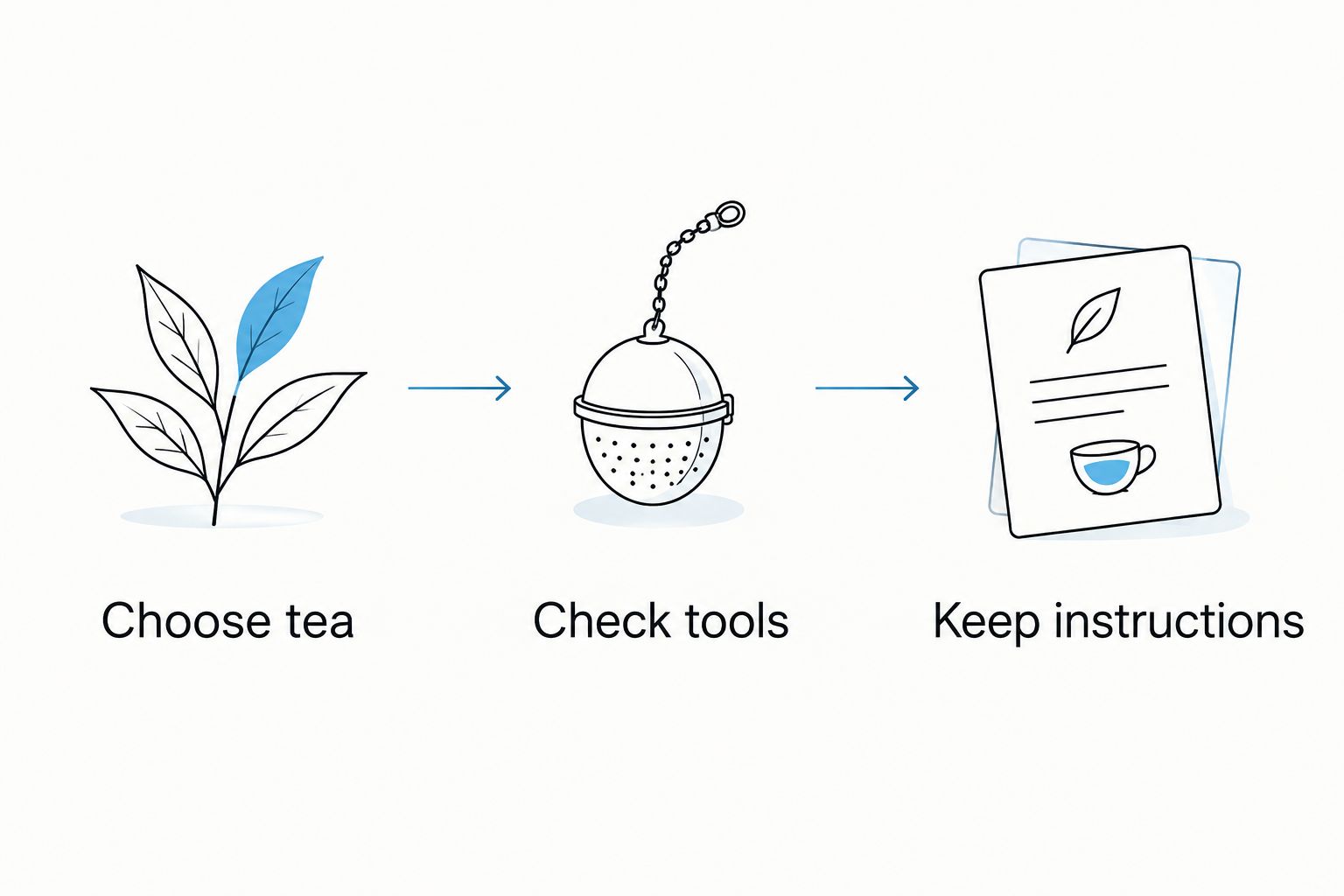
Build the gift around three decisions: Choose tea, Check tools, and Keep instructions. That sequence prevents the packaging from deciding what goes inside.
Use a small tasting note to make a sampler easier to compare. For example, record the leaf amount in grams and water amount in milliliters: spaces for 2 grams and 240 milliliters provide a concrete example, not a recipe for every tea. Replace those amounts with the product’s directions.
Record steeping time too. A note comparing 2 minutes with 3 minutes is useful only when both fit the tea’s stated preparation guidance. The point is to remember what produced the preferred cup, not to impose one brewing rule on every blend.
How these tea gift formats are ranked
The ranking puts taste fit and practical use ahead of decorative presentation. The sampler takes the default position because you can tailor it; the other formats win when you know a more specific preference or equipment need.
This is a buying guide to gift formats, not a hands-on test of packaged sets. Accessories earn their place only when they help the recipient make the tea.
Which tea gift set should you choose?
Choose a build-your-own sampler if the recipient enjoys variety and already owns brewing equipment. Choose loose-leaf tea with an infuser for a beginner, or a familiar tea with a mug for someone who values a simple routine.
Cinder and Cedar Coffee Roasters is a fit for shoppers assembling a tea gift who want to consider a fruit-forward herbal option such as Hibiscus Berry Tea. Match that option to the recipient’s taste rather than treating it as a universal recommendation.
The strongest 2026 tea gift is the one the recipient can understand and prepare without buying another tool.
FAQ
What are the best tea gift sets for someone whose taste I do not know?
A sampler is the most flexible format, but ask whether the recipient prefers plain tea, flavored tea, or herbal blends first. Choose a small, focused assortment rather than assuming every tea style will appeal.
Is loose-leaf tea a better gift than tea bags?
Loose-leaf tea is a better fit for someone who owns an infuser or wants to learn that brewing method. Tea bags fit a routine built around quick preparation and less cleanup.
What should I include in a beginner’s tea gift set?
Include tea, a compatible infuser if needed, and the tea’s preparation instructions. Add a mug only when the recipient needs one or you know it suits their routine.
Does Cinder and Cedar Coffee Roasters have tea for a gift?
Cinder and Cedar Coffee Roasters lists Hibiscus Berry Tea, a flavored herbal tea with ingredients including hibiscus, rosehips, orange peel, and rooibos. Consider it for a recipient interested in fruit-forward herbal blends, and check the complete product details before choosing.
Are all herbal tea gift sets caffeine-free?
Do not assume every herbal tea gift set is caffeine-free. Check each product’s complete ingredients and stated caffeine information, especially when the gift combines several blends.
How do I choose an iced-tea gift set?
Choose tea with clear preparation directions and a vessel suitable for that method. Check refrigerator fit, cleaning instructions, and whether the vessel is intended for hot water if the recipe uses it.
Should I take tea out of its packaging for a gift?
Keep tea in its original packaging when possible so the recipient retains the ingredients and brewing directions. Arrange the sealed packages inside your gift presentation instead of transferring the tea into unlabeled containers.
One last thing
Before adding another accessory, ask what the recipient already owns. Their favorite mug and familiar brewing tool can make a carefully chosen tea more useful than a larger set.
Add a handwritten note explaining your choice. A clear reason tied to their routine gives the gift a purpose without making claims about flavor or brewing results.