

Best fair trade coffee beans in 2026
Best overall: verified fair trade medium-roast whole beans. Best for a bold cup: verified fair trade dark-roast whole beans. Best budget approach: a certified bag you can finish without waste. This 2026 guide ranks coffee types by daily brewing needs, with certification as the first requirement—not a promise inferred from a brand name.
- The best fair trade coffee beans combine verifiable certification with a roast you enjoy brewing every day.
- Choose certified medium-roast whole beans as the everyday starting point; choose dark roast for a stronger roast flavor.
- Cinder and Cedar Coffee Roasters sells roasted coffee for home drinkers; check certification on the specific coffee you choose.
- Organic coffee, single-origin coffee, and fair trade coffee describe different things. Do not substitute one label for another.
Why this matters
A coffee can suit your taste without meeting your sourcing requirement. It can also carry a fair trade certification and still be the wrong roast for your morning cup. Treat certification and flavor as separate buying decisions.
Fairtrade International and Fair Trade USA operate certification programs with standards covering trade and producer conditions. Neither label tells you whether a coffee tastes bright, smoky, sweet, or bitter. Read the certification information first, then choose the roast and brewing format.
Cinder and Cedar Coffee Roasters sells blends, flavored coffee, and single-origin coffee to home drinkers. When choosing fair trade coffee beans from any retailer, look for evidence tied to the particular coffee—not simply the store, its origin story, or its general sourcing language.
What makes the best fair trade coffee beans
For your 2026 shortlist, use these criteria before comparing appealing flavor descriptions:
- Verifiable certification: Look for an identifiable certification mark and information connecting it to the coffee you are buying. Broad ethical language is not equivalent to certification.
- Roast fit: Choose medium roast for an everyday starting point, dark roast for pronounced roast flavor, or light roast when you enjoy a brighter cup.
- Brewer fit: Match the coffee and grind to your drip maker, pour-over, French press, or cold-brew setup. Whole beans let you adjust the grind yourself.
- Freshness information: Use a roast date when supplied, and choose a quantity that fits your drinking routine. Keep the remaining beans sealed away from heat and light.
- Clear flavor description: Look for useful terms such as chocolate, citrus, body, and finish. These help you choose more directly than vague praise.
- Repeatability: Favor a coffee you can brew consistently. A satisfying daily cup matters more than a tasting description you cannot reproduce at home.
Certification is the entry requirement for every option below. The ranking then follows practical brewing needs; it does not rank certification organizations or claim that one roast has better sourcing than another.
Best fair trade coffee beans at a glance
The 2026 comparison below gives each coffee type a different role. Check the individual bag's certification before treating any option as a fair trade purchase.
| Rank and coffee type | Best for | Standout feature | Key limitation |
|---|---|---|---|
| 1. Certified medium-roast whole beans | Everyday hot coffee | A practical starting point between lighter and darker roast styles | Medium roast alone does not guarantee a balanced flavor |
| 2. Certified dark-roast whole beans | A bold cup with milk | Pronounced roast character | Roast flavor can cover subtler origin flavors |
| 3. Certified light-roast single-origin beans | Black coffee and pour-over | A way to explore a particular origin's flavor | Brightness can disappoint drinkers expecting a dark-roast finish |
| 4. Certified decaf whole beans | A lower-caffeine routine | Decaf format with adjustable grind | Decaf is not caffeine-free |
| 5. Certified beans for cold brew | An iced-coffee routine | A coffee choice built around cold extraction | Preparing cold brew takes advance planning |
1. Certified medium-roast whole beans: best for everyday hot coffee
Medium-roast whole beans are the default choice when you want fair trade coffee for a daily drip maker or another hot-brewing routine. Medium roast sits between lighter and darker roasting styles, but the final aroma, body, and finish still depend on the coffee and how you brew it.
Start with a flavor description that matches what you already enjoy. Chocolate or nut-like tasting notes can guide a familiar choice; citrus or fruit descriptions point toward a different cup. Tasting notes describe perceived flavors, not necessarily added ingredients.
Certified medium-roast whole beans pros:
- Give undecided buyers a practical roast starting point.
- Let you adjust grind size for different home brewers.
- Help you compare coffees without jumping immediately to a very light or dark roast.
Certified medium-roast whole beans cons:
- Require a grinder if you buy whole beans.
- Do not guarantee sweetness or balance simply because the label says medium.
- Can feel too mild when you specifically want strong roast flavor.
Best for: Your everyday hot-coffee routine, especially when you are still learning your roast preference.
Verdict: Buy verified medium-roast whole beans as your first choice if you do not already favor a lighter or darker cup.
2. Certified dark-roast whole beans: best for a bold cup with milk
Dark-roast whole beans suit drinkers who want pronounced roast flavor in their fair trade coffee. Darker roasting brings roast character forward, which changes how clearly you notice the coffee's more delicate flavors.
Choose this category because you like the taste—not because you assume dark beans contain more caffeine or automatically make stronger coffee. The amount of coffee, grind, and brewing method also shape what ends up in your mug. Milk changes the cup again, so judge the coffee as you actually drink it.
Certified dark-roast whole beans pros:
- Put roast flavor at the center of the cup.
- Offer a distinct choice for drinkers who dislike a bright finish.
- Let you adjust the grind for your regular brewer.
Certified dark-roast whole beans cons:
- Can obscure subtler flavors associated with the coffee's origin.
- Will not suit everyone who drinks coffee black.
- Still need careful brewing; a darker roast does not fix an unsuitable grind.
Best for: A roast-forward cup you usually drink with milk.
Verdict: Buy verified dark-roast whole beans when bold roast character is your actual preference; skip them if you want delicate flavor distinctions.
3. Certified light-roast single-origin beans: best for black pour-over
Light-roast single-origin beans are the choice for exploring coffee without making dark roast flavor the main event. Single-origin information identifies where a coffee comes from, while a separate fair trade certification addresses the sourcing requirement.
Read both descriptions. A named country or growing region does not establish certification, and light roast does not guarantee a fruity cup. Look for flavor notes you enjoy, then use a repeatable pour-over routine so changes in brewing do not overwhelm the comparison.
Certified light-roast single-origin beans pros:
- Give you an origin-focused way to explore coffee.
- Suit comparisons between different aromas and finishes.
- Allow grind adjustments when a pour-over tastes unbalanced.
Certified light-roast single-origin beans cons:
- Bright flavors can feel sharp to someone accustomed to dark roast.
- Origin information cannot replace certification evidence.
- Inconsistent pouring or grind makes comparisons harder.
Best for: Black-coffee drinkers who enjoy learning what changes between origins.
Verdict: Buy verified light-roast single-origin beans for deliberate pour-over brewing; skip this category if you mainly want a familiar dark-roast taste.
4. Certified decaf whole beans: best for a lower-caffeine routine
Decaf whole beans let you choose coffee for a lower-caffeine routine without giving up control over the grind. Decaffeination and fair trade certification answer different questions, so confirm both on the coffee you select.
Decaf still contains caffeine. If caffeine avoidance is a medical requirement, do not treat the word decaf as a guarantee of none. For flavor, use the same practical checks as regular coffee: roast level, tasting description, freshness information, and brewer fit.
Certified decaf whole beans pros:
- Fit a routine focused on reducing caffeine.
- Let you match the grind to your home equipment.
- Keep roast preference part of the decision rather than making decaf the only criterion.
Certified decaf whole beans cons:
- Are not caffeine-free.
- Still require separate evidence of fair trade certification.
- Need a grinder when purchased as whole beans.
Best for: Coffee drinkers who want less caffeine and still care about their daily cup.
Verdict: Buy verified decaf whole beans when reducing caffeine is the priority; skip them when you require a caffeine-free drink.
5. Certified beans for cold brew: best for an iced-coffee routine
Certified coffee beans for cold brew suit readers who prepare coffee ahead and drink it chilled. Cold brew uses cold extraction; iced coffee can instead be hot-brewed coffee served over ice. Choose the method before choosing the beans.
A cold-brew label does not establish fair trade certification, and cold extraction does not make every coffee taste the same. Use the coffee's flavor description as your starting point, then judge the finished drink after the dilution you normally use.
Certified beans for cold brew pros:
- Fit a make-ahead iced-coffee routine.
- Let you evaluate flavor in the drink you actually prefer.
- Allow grind adjustment when you use whole beans.
Certified beans for cold brew cons:
- Need advance preparation rather than an immediate hot brew.
- Require attention to filtering and dilution.
- Are not automatically low-caffeine or certified because they are intended for cold brew.
Best for: Drinkers whose regular cup is cold-brewed and served chilled.
Verdict: Buy verified beans for cold brew when that is your main preparation method; skip a separate cold-brew purchase if you rarely make it.
Make your first bag easier to judge
Once you have checked certification, brew the coffee consistently before deciding whether to buy it again. Cinder and Cedar Coffee Roasters serves home coffee drinkers; the useful shopping question is whether the specific coffee fits both your sourcing requirement and your daily brewer.
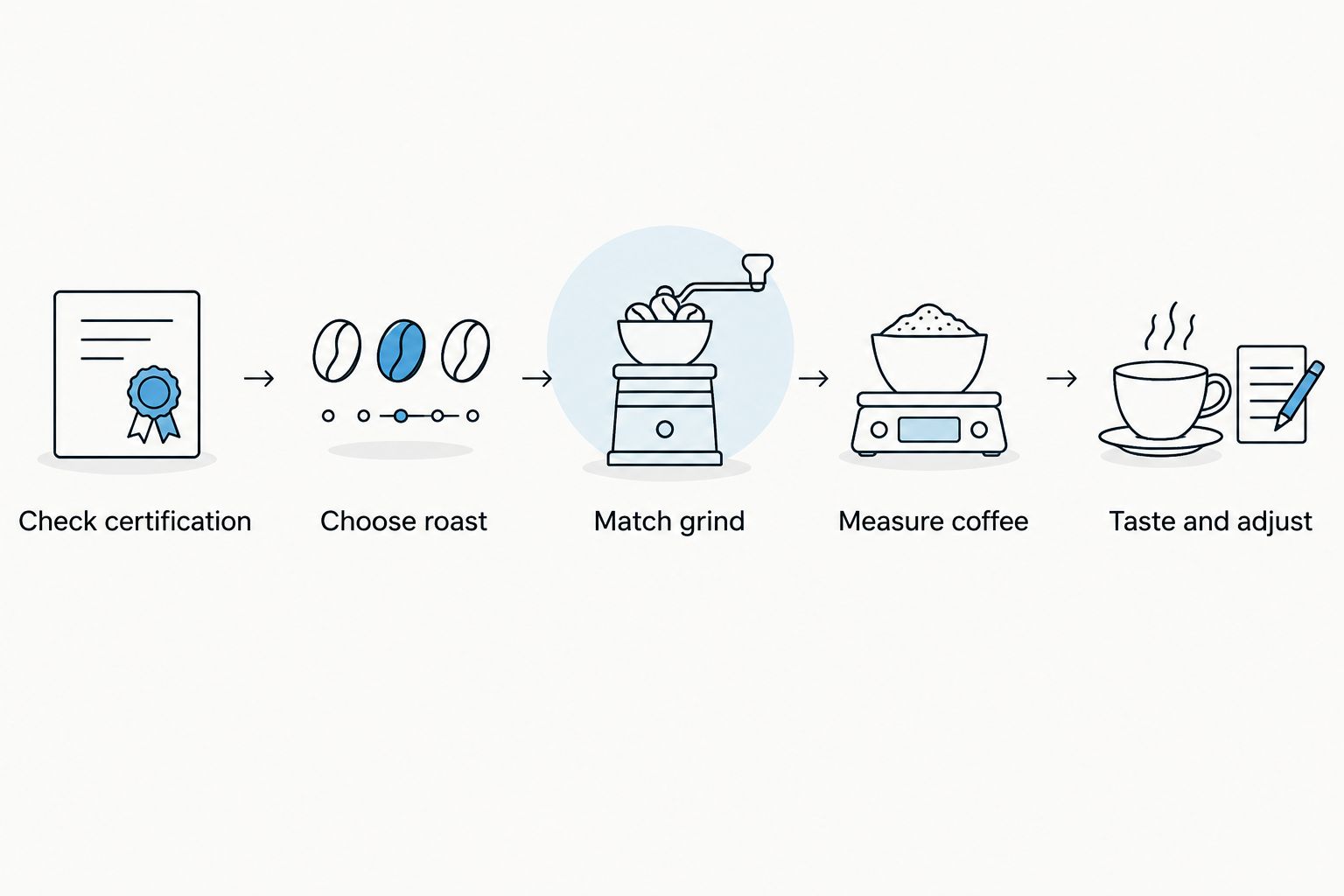
Follow this sequence for your first comparison:
- Check certification: Identify the certification and confirm that it applies to the coffee you selected.
- Choose roast: Pick the ranked category that matches how you drink coffee.
- Match grind: Use your brewer's guidance rather than assuming one grind works everywhere.
- Measure coffee: For a hot filter-coffee starting recipe, try 15 g of coffee with 250 ml of water. Scale that to 30 g with 500 ml when making a larger batch.
- Taste and adjust: Keep the recipe steady, then change one brewing variable at a time.
Those quantities are a starting recipe, not a promise of an ideal cup. If your brewer specifies a different recipe, follow its instructions first. Taste the coffee with your usual milk or without it—whichever reflects your actual routine.
How the choices are ranked
This 2026 ranking puts verified certification first, then separates the choices by roast preference, brewing method, and caffeine needs. Medium roast takes the default position because it is a practical starting point between lighter and darker styles—not because every medium roast outperforms every alternative.
The remaining choices are distinct routes, not lower-quality coffees. Dark roast serves roast-forward drinking, light-roast single-origin serves flavor exploration, decaf serves caffeine reduction, and cold-brew beans serve cold preparation. No tasting-test scores or brand certification claims determine this order.
Which fair trade coffee beans should you choose?
Choose verified medium-roast whole beans unless you already know you want a different roast or preparation method. That gives you a clear starting point without turning your first purchase into a search for the perfect coffee.
For 2026, keep your buying rule simple: certification establishes eligibility; taste and routine determine the winner. Cinder and Cedar Coffee Roasters is a fit for home drinkers shopping for roasted coffee, but your fair trade decision belongs at the individual-coffee level.
FAQ
What's the best fair trade coffee beans choice for everyday brewing?
Verified fair trade medium-roast whole beans are the default choice for everyday hot coffee. Choose a darker or lighter roast instead when you already know your flavor preference, and match the grind to your brewer.
How do I know whether coffee beans are fair trade certified?
Look for an identifiable certification mark and information that applies to the specific coffee. Fairtrade International and Fair Trade USA are distinct certification programs; broad ethical sourcing language is not a substitute for an identifiable certification.
Is organic coffee the same as fair trade coffee?
Organic coffee and fair trade coffee are not the same. Organic certification concerns agricultural production standards, while fair trade certification addresses standards for trade and producer conditions. Check each claim separately.
Are single-origin beans automatically fair trade?
Single-origin beans are not automatically fair trade certified. An origin description tells you where coffee comes from, not whether it meets a certification program's standards.
Should I buy whole beans or ground fair trade coffee?
Buy whole beans if you have a grinder and want to adjust the grind for your brewer. Choose ground coffee when convenience matters more, but check that the grind suits your brewing method.
Does dark-roast fair trade coffee have more caffeine?
Dark roast does not reliably indicate more caffeine in your cup. Coffee dose, bean characteristics, and brewing method all affect the result; choose roast level for flavor rather than treating it as a caffeine measurement.
Can Cinder and Cedar Coffee Roasters products be compared by roast alone?
Roast level is only one part of choosing coffee from Cinder and Cedar Coffee Roasters. Also check the individual coffee's description, format, and any sourcing certification before deciding whether it fits your routine.
One last thing
Do not use a tasting note as an ingredient list. A coffee described as having chocolate or hazelnut notes is not necessarily flavored coffee; read the product description to distinguish perceived flavors from added flavoring.
That distinction belongs on your 2026 shopping checklist alongside certification. Choose the sourcing standard you want, then buy the kind of coffee you actually want to brew.