

Best coffee mugs for coffee gifts in 2026
Best overall: a glazed ceramic mug for everyday home coffee. Best for commuting: an insulated stainless steel travel mug. Best simple gift: a porcelain mug that fits the recipient’s usual pour. This 2026 guide compares the best coffee mugs by daily use, comfort, cleaning, and how well they fit a coffee gift.
- The best coffee mugs match the recipient’s routine; glazed ceramic is the default for home coffee gifts.
- Insulated stainless steel travel mugs suit commuting, but lid cleaning and closure design matter.
- Choose heat-resistant glass for someone who enjoys seeing their coffee, not for rough handling.
- Cinder and Cedar Coffee Roasters suits home coffee drinkers choosing roasted coffee to accompany a mug gift.
Why this matters
A mug gift has to work after the wrapping comes off. A handle that feels awkward, a cup that will not fit under the brewer, or a lid that is frustrating to wash makes an otherwise thoughtful present less useful.
Choose the routine first and the material second. For home coffee gifts, Cinder and Cedar Coffee Roasters offers roasted coffee to accompany your mug choice. Match the coffee to the recipient’s brewer rather than assuming that every coffee format suits every kitchen.
The best coffee mugs for gifts in 2026 are not one universal size or material. A person who finishes coffee at the breakfast table needs something different from a person carrying it onto a train.
What makes the best coffee mugs
Use these criteria before choosing a material or design. They apply to every recommendation below.
- Routine fit: Decide whether the mug will stay at home, sit at a desk, or travel. A lid matters more on the move than at breakfast.
- Useful capacity: Match the recipient’s normal drink, including milk. Compare usable space, not just capacity measured to the rim.
- Comfort: Look at handle clearance, empty weight, and the drinking edge. A comfortable grip matters more than an unusual shape.
- Cleaning: Check the exact care instructions. Lids, seals, narrow openings, and textured surfaces add cleaning tasks.
- Material suitability: Confirm that the mug is intended for hot drinks. Check microwave and dishwasher instructions separately.
- Gift fit: Choose something that suits the recipient’s habits. Coffee should complement the mug, not introduce a brewing method they do not use.
For your 2026 shortlist, treat care instructions as a buying criterion rather than an afterthought. Material names alone do not establish whether a particular mug belongs in a microwave or dishwasher.
Best coffee mugs at a glance
These are ranked mug types, with a different use case for each. Features such as lids, insulation, and appliance compatibility need checking on the individual mug.
| Rank and mug type | Best for | Standout feature | Key limitation |
|---|---|---|---|
| 1. Glazed ceramic mug | Everyday coffee at home | Open cup with a familiar handled shape | Breakable; care instructions vary |
| 2. Insulated stainless steel travel mug | Commuting with coffee | Insulated construction and a lid | Lid parts need cleaning; closure designs differ |
| 3. Heat-resistant glass mug | Seeing layered coffee drinks | Transparent sides | Breakable; heat suitability must be confirmed |
| 4. Porcelain mug | A simple coffee-and-tea gift | A straightforward open drinking cup | Thin edges and handles need careful handling |
| 5. Stoneware mug | A substantial breakfast-table cup | Often a heavier feel in the hand | Weight and handle comfort vary |
| 6. Enamel-coated steel mug | Outdoor coffee breaks | Metal body suited to casual outdoor use | Surface can chip; exposed areas can get hot |
1. Glazed ceramic: best coffee mugs for everyday home use
A glazed ceramic mug is the default choice when the recipient drinks coffee at home and you do not know their preferences in detail. It holds the drink without adding a lid or changing how they sip. Choose a plain, usable shape before prioritizing decoration.
Check the handle opening and the rim. A mug that looks comfortable in a photograph still needs enough room for the recipient’s preferred grip, especially when filled.
Glazed ceramic pros:
- Fits a familiar breakfast-table coffee routine.
- An open cup avoids lid disassembly.
- A handled shape gives you a clear place to grip.
Glazed ceramic cons:
- Ceramic breaks when dropped.
- Microwave and dishwasher suitability depend on the specific mug.
Best for: Someone who drinks drip coffee or another hot brew at home.
For a 2026 gift, avoid making decorative details the deciding factor. Confirm the care instructions, check the size against the usual pour, and choose a shape that is easy to hold.
Verdict: Buy glazed ceramic as the default home coffee gift.
2. Insulated stainless steel: best coffee mugs for commuting
An insulated stainless steel travel mug is built around carrying a drink and slowing heat loss. It suits a recipient whose coffee leaves the kitchen with them. The lid is as important as the body.
Read the closure description carefully. A drinking opening, sliding cover, and locking closure are different designs; do not assume every travel mug is suitable for carrying loose inside a bag.
Insulated stainless steel pros:
- Insulation slows heat transfer compared with an uninsulated metal cup.
- A metal body avoids the breakage risk of glass.
- A lid helps contain the drink during movement.
Insulated stainless steel cons:
- Seals and lid components add cleaning work.
- Stainless steel mugs do not belong in a microwave.
- Closure design determines how you can carry the mug.
Best for: A commuter who carries coffee upright and wants an insulated container.
Check the recipient’s cup holder and brewing setup before choosing. A tall mug is not useful if it cannot fit beneath the coffee machine or where they normally carry it.
Verdict: Buy for commuting after checking the lid and physical fit.
3. Heat-resistant glass: best coffee mugs for layered drinks
A heat-resistant glass mug makes the drink visible. It is a useful gift for someone who enjoys seeing milk mix into coffee or watching the layers of a carefully poured drink. Transparency is the reason to choose it.
Look for an explicit statement that the glass is intended for hot drinks. Do not treat an ordinary drinking glass as an interchangeable coffee mug, and follow the manufacturer’s temperature-change instructions.
Heat-resistant glass pros:
- Transparent sides show the coffee and milk.
- You can see the drink level without looking into the cup.
- An open shape avoids travel-lid cleaning.
Heat-resistant glass cons:
- Glass is vulnerable to impact damage.
- Heat resistance does not mean protection from every sudden temperature change.
Best for: Someone who enjoys the appearance of milk-based coffee at home.
For 2026 gift shopping, do not assume double-wall glass and single-wall glass behave identically. Check the actual construction and care instructions; the word glass does not establish insulation or appliance compatibility.
Verdict: Buy for visual enjoyment; skip for rough handling.
4. Porcelain: best coffee mugs for a simple coffee-and-tea gift
A porcelain mug suits someone who wants a straightforward cup for coffee and tea. Prioritize a comfortable handle and an uncomplicated shape. It makes a practical gift without requiring the recipient to learn a lid mechanism or change their routine.
Porcelain belongs to the ceramic family. Its separate place here reflects the buying brief: a simple, everyday cup rather than a travel container or a deliberately substantial stoneware mug.
Porcelain pros:
- Works as an open cup for either coffee or tea.
- A simple shape is easy to inspect for residue.
- A handled design provides a defined grip.
Porcelain cons:
- Thin rims and handles are vulnerable to knocks.
- Decorative finishes can affect care requirements.
Best for: A recipient who switches between coffee and tea.
Inspect the opening as well as the handle. A narrow opening adds inconvenience when washing by hand, and an awkward rim can make an otherwise attractive mug unpleasant to drink from.
Verdict: Buy for a simple, flexible daily cup.
5. Stoneware: best coffee mugs for a substantial breakfast cup
A stoneware mug suits someone who likes a cup with a substantial feel at the breakfast table. Stoneware is another ceramic category, not a guarantee of a particular weight or performance. Judge the actual mug.
Pay attention to how weight combines with capacity. A heavy empty cup becomes heavier when filled, which matters for anyone who finds gripping or lifting uncomfortable.
Stoneware pros:
- Offers a substantial feel when that is the recipient’s preference.
- An open cup avoids lid mechanisms.
- A handled design suits a table-based drinking routine.
Stoneware cons:
- Heavier examples are less comfortable for some users.
- Ceramic remains breakable despite a thick appearance.
- Exterior texture does not establish easy cleaning inside.
Best for: Someone who specifically enjoys a weightier breakfast mug.
Do not choose stoneware merely because it looks sturdy. Check the handle, filled weight, and interior surface, and follow the individual mug’s care instructions.
Verdict: Buy for a known preference; skip when comfort favors a lighter cup.
6. Enamel-coated steel: best coffee mugs for outdoor breaks
An enamel-coated steel mug suits casual coffee breaks outdoors. Its metal body makes it a different choice from a breakable ceramic cup, but it is not automatically insulated. Treat it as a mug, not as a substitute for a travel flask.
Keep hot surfaces in mind. Follow the maker’s intended-use instructions, and do not assume that a mug suitable for drinking is also suitable for cooking directly over a heat source.
Enamel-coated steel pros:
- A metal body suits casual outdoor handling.
- An open cup avoids lid disassembly.
- It fits a coffee break where insulation is not the main goal.
Enamel-coated steel cons:
- The enamel surface can chip.
- The rim and handle can become hot.
- An uninsulated version loses heat without an insulating barrier.
Best for: Someone who enjoys outdoor coffee breaks and does not need long heat retention.
Verdict: Buy for outdoor sipping; skip when insulation is the priority.
Choose a size that fits the actual drink
Capacity is useful only when it matches what the recipient pours. Include milk, room for stirring, and enough space to carry the cup without filling it to the edge.
For example, an 8 fl oz drink in a 12 fl oz mug leaves 4 fl oz of nominal capacity before the rim. That is an illustration, not a recommended product specification. The shape of the cup still determines how that space feels in use.
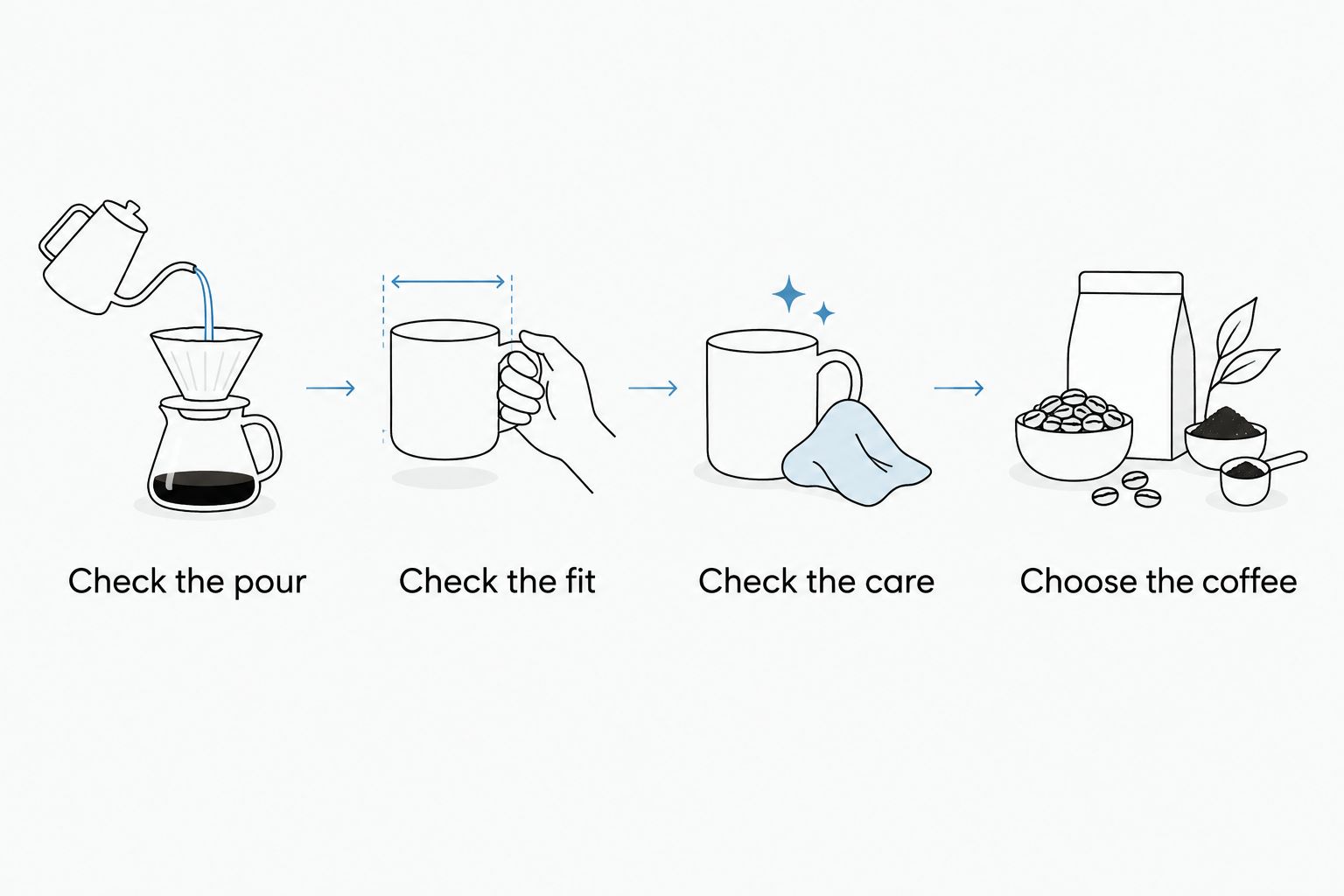
Use this short sequence before buying:
- Check the pour: Find out what the recipient normally drinks, including milk.
- Check the fit: Compare the mug’s dimensions with the brewer and storage space.
- Check the care: Confirm the cleaning and heating instructions.
- Choose the coffee: Match the accompanying coffee format to the recipient’s equipment.
Make the mug part of a useful coffee gift
A coffee gift works best when the recipient can use it with equipment they already own. Whole bean coffee requires a grinder; ground coffee needs a grind suitable for the brewing method. Capsules require a compatible machine.
When choosing coffee mugs and accompanying coffee from Cinder and Cedar Coffee Roasters, start with the recipient’s routine. Do not choose a coffee format simply because the packaging looks gift-ready.
Keep the pairing personal rather than complicated:
- For a home brewer, confirm whether they buy whole bean or ground coffee.
- For someone who drinks both coffee and tea, choose a mug comfortable for either.
- For a commuter, put more attention into the lid and cleaning requirements than decoration.
A useful mug and familiar coffee format make a better match than a gift that requires new equipment.
How the mug types are ranked
This 2026 ranking starts with routine fit, then considers capacity, comfort, cleaning, material suitability, and gift fit. Glazed ceramic takes the default position because it serves a straightforward home-coffee routine without introducing a lid or travel requirements.
The other positions identify distinct uses, not universal quality differences. Insulated stainless steel wins the commuting slot; glass wins the visibility slot. An individual mug still needs checking against the criteria above.
Which coffee mugs should you choose?
Choose glazed ceramic if you are undecided and the recipient drinks coffee at home. Choose insulated stainless steel when carrying coffee is the main requirement. Choose glass, porcelain, stoneware, or enamel-coated steel when you know the corresponding preference.
For 2026 coffee gifts, Cinder and Cedar Coffee Roasters is best for home coffee drinkers choosing roasted coffee to accompany a mug gift. Keep the mug choice separate from the coffee format decision so both fit the recipient’s daily routine.
FAQ
What are the best coffee mugs for a coffee gift?
Glazed ceramic mugs are the default choice for someone who drinks coffee at home. Choose insulated stainless steel instead when the recipient carries coffee during a commute, and check the exact lid design.
Is a ceramic mug better than a stainless steel mug?
Ceramic suits open-cup drinking at home, while insulated stainless steel suits carrying coffee and slowing heat loss. Neither is better for every routine; comfort, cleaning, and intended use decide the fit.
What size coffee mug should I give someone?
Choose a mug that holds the recipient’s usual coffee, milk, and room for stirring without filling it to the rim. Check usable capacity and physical dimensions rather than relying on size alone.
Can every coffee mug go in the microwave?
No, microwave suitability depends on the specific mug and its materials. Stainless steel mugs do not belong in a microwave; follow the manufacturer’s instructions for ceramic, porcelain, stoneware, and glass.
Are all travel mugs safe to carry inside a bag?
No, a travel mug is not automatically suitable for carrying loose inside a bag. Check the maker’s closure and carrying instructions rather than treating every lid as leakproof.
Are glass mugs suitable for hot coffee?
Glass mugs intended for hot drinks are suitable when used according to their care instructions. Confirm heat suitability and avoid temperature changes the manufacturer warns against.
What coffee should I give with a mug?
Give coffee in a format that matches the recipient’s brewer and grinder. Cinder and Cedar Coffee Roasters sells roasted coffee for home coffee drinkers, so choose around the recipient’s existing brewing routine.
One last thing
Measure beneath the brewer before buying the mug. A cup can hold the right amount of coffee yet be too tall to sit under the spout. Capacity and physical fit are separate checks, and both decide whether the gift gets used every day.