

Best Coffee Beans for French Press: Top Picks 2026
Best overall: a medium-roast whole-bean blend. Best for a bold cup: French Roast. Best flavored option: French Vanilla. This 2026 guide helps you choose the best coffee beans for french press by roast, grind, flavor, and the way you brew each morning.
- The best coffee beans for french press match your taste; medium-roast whole beans are the everyday starting point.
- Cinder and Cedar Coffee Roasters’ French Roast suits French press drinkers who want a bold, deep-dark cup.
- French Vanilla is the flavored choice; choose an unflavored blend when you want to taste the coffee itself.
- Use a coarse grind, measure your coffee and water, and pour the finished brew out of the press.
Why this matters
A French press uses a metal filter rather than a paper filter. More coffee oils and fine particles reach your cup, giving the brew a fuller texture and some sediment. The beans matter, but so does the grind.
French press is a brewing method, not a roast requirement. You do not need French roast to use a French press. Start with the flavor you enjoy, then choose a grind that suits the brewer. Cinder and Cedar Coffee Roasters sells blends, flavored coffee, and single-origin coffee for home drinkers; this guide separates those choices by everyday use.
What makes the best coffee beans for French press?
Use these criteria to choose your coffee in 2026. A coffee that fits your routine beats a darker roast you buy only because its name sounds right.
- Roast fit: Medium roast is the starting point for a balanced everyday cup. Dark roast suits a more roast-forward preference; light roast suits a brighter cup.
- Grind fit: Choose whole beans if you can grind them yourself. For ground coffee, look for an explicitly coarse or French-press grind.
- Flavor fit: Decide whether you want the coffee’s own flavor or an added flavor such as vanilla. Neither choice requires sweetener.
- Freshness information: Use a stated roast date when one is provided. Keep coffee sealed and away from heat, moisture, and direct sunlight.
- Routine fit: Whole beans add a grinding step. Ground coffee removes that step but gives you less control over particle size.
- Finish: Pay attention to what stays after a sip: roast bitterness, brightness, added flavor, or a clean finish. Choose the version you want to drink daily.
French press coffee options at a glance
This 2026 comparison ranks choices by use case, not by an unsupported taste score. Named products use their supplied descriptions; the other rows describe coffee styles you can choose across sellers.
| Rank and option | Best for | Standout feature | Key limitation |
|---|---|---|---|
| 1. French Roast | Bold, roast-forward coffee | Deep-dark roast of African coffees | Not the choice for a light, bright cup |
| 2. Medium-roast whole-bean blend | Everyday brewing with a grinder | Lets you set the grind for your press | Requires a grinder and another preparation step |
| 3. French Vanilla | An added vanilla flavor | Medium-roast flavored coffee | Vanilla changes the coffee’s own flavor |
| 4. Light-roast single-origin coffee | Exploring brighter flavors | Focuses your choice on a particular origin | Needs careful brewing to avoid a sharp, thin cup |
| 5. Coarse-ground medium-roast coffee | A routine without grinding | Ready to measure and brew | You cannot adjust the grind after buying |
1. French Roast: best French press coffee for a bold cup
French Roast from Cinder and Cedar Coffee Roasters is described as a deep-dark roast of African coffees with a bold, rich coffee flavor. The supplied description also identifies shiny beans with an oil sheen. Choose it because you enjoy dark-roast flavor, not because French press requires it.
There are two products named French Roast in the supplied catalog. This recommendation refers to the African-coffee version; the other is described as a dark-roast blend from Central America. The product card below identifies the version discussed here.
French Roast pros:
- Its stated deep-dark roast gives you a clear flavor direction.
- It suits drinkers who prefer bold coffee over a bright cup.
- Its description identifies the coffees as African.
French Roast cons:
- Deep-dark roast is not the right match for a light-roast preference.
- The product name alone does not identify its grind or distinguish the two catalog entries.
Best for: You want a bold, roast-forward French press coffee and already enjoy dark roasts.
Verdict: Buy for dark-roast taste; skip if you want a bright cup. Check the selected format before ordering rather than assuming the name means French-press ground.
2. Medium-roast whole-bean blend: best for everyday brewing
A medium-roast whole-bean blend is the default recommendation for an undecided French press drinker. It gives you a starting point between light and dark roast, while whole beans let you choose the grind yourself. The blend label does not guarantee particular flavors, so read the actual description.
For your everyday cup, look for familiar flavor descriptions you already enjoy. Chocolate or nut notes describe flavor impressions unless the product explicitly says those ingredients are added. That distinction matters when you compare an unflavored blend with flavored coffee.
Medium-roast whole-bean blend pros:
- You control the grind for your particular French press.
- You grind only the coffee you need for the next brew.
- Medium roast is a useful starting point when your roast preference is undecided.
Medium-roast whole-bean blend cons:
- You need a grinder; a burr grinder helps produce more even particles.
- Different blends taste different, even when both say medium roast.
Best for: You own a grinder and want a repeatable everyday coffee rather than a strongly flavored specialty choice.
Verdict: Buy as your default starting point. Change the brewing recipe before replacing the beans after one disappointing cup.
3. French Vanilla: best for a vanilla-flavored routine
French Vanilla from Cinder and Cedar Coffee Roasters is a medium-roast flavored coffee described as rich, creamy, well rounded, and smooth. Those are the product’s stated flavor descriptions, not claims that the brewed coffee contains cream. Choose this option when vanilla is part of the cup you want.
Added flavor and roast level answer different questions. French Vanilla supplies a vanilla direction, while its medium roast describes the roast. It is not interchangeable with French Roast despite the shared word in their names.
French Vanilla pros:
- The named vanilla flavor makes the choice straightforward.
- Its stated medium roast suits buyers who are not seeking a deep-dark roast.
- It gives flavored-coffee drinkers a distinct option in this comparison.
French Vanilla cons:
- Added flavor is a drawback when you want the coffee’s own flavor alone.
- The supplied description does not establish sweetness, ingredients, or grind options.
Best for: You enjoy vanilla-flavored coffee and want that flavor in your French press routine.
Verdict: Buy for vanilla flavor; skip for unflavored coffee tasting. Check the product details if ingredients or dietary requirements affect your choice.
These two Cinder and Cedar Coffee Roasters French press recommendations serve different tastes: French Roast for a deep-dark cup and French Vanilla for added vanilla flavor. Confirm the coffee format fits your brewer before selecting either.


4. Light-roast single-origin coffee: best for brighter flavors
Light-roast single-origin coffee is the choice for exploring a brighter cup rather than emphasizing dark-roast flavor. Single-origin identifies a source; it does not promise a particular taste or quality. Read the flavor description alongside the roast label.
French press can brew light-roast coffee. You do not need to move to another brewer, but a very coarse grind or insufficient extraction can leave the cup sharp and thin. Use your first brew to decide whether the recipe needs adjustment.
Light-roast single-origin coffee pros:
- It offers an alternative to roast-forward dark coffee.
- A stated origin gives you a specific source to explore.
- You can compare different coffees using the same brewer and recipe.
Light-roast single-origin coffee cons:
- It is not the default for someone who dislikes bright flavors.
- The origin name alone does not tell you how the coffee tastes.
Best for: You drink coffee black and want to explore brighter flavors.
Verdict: Buy for exploration; skip if bold dark roast is your clear preference.
5. Coarse-ground medium-roast coffee: best without a grinder
Coarse-ground medium-roast coffee makes sense when you want to measure, pour, and brew without grinding first. The important word is coarse. A bag marked only ground does not establish that the grind suits a French press.
This option shares the medium-roast starting point with the whole-bean recommendation, but serves a different routine. Choose it for fewer preparation steps, not greater control.
Coarse-ground medium-roast coffee pros:
- You do not need a grinder.
- Preparation is straightforward: measure the grounds and add water.
- An explicitly suitable grind removes guesswork at purchase.
Coarse-ground medium-roast coffee cons:
- You cannot make the particles coarser or finer afterward.
- Ground coffee exposes more surface area to air than whole beans.
Best for: You want French press coffee without adding a grinding step.
Verdict: Buy when the grind is explicitly suitable; skip unspecified ground coffee.
How to brew your first comparison cup
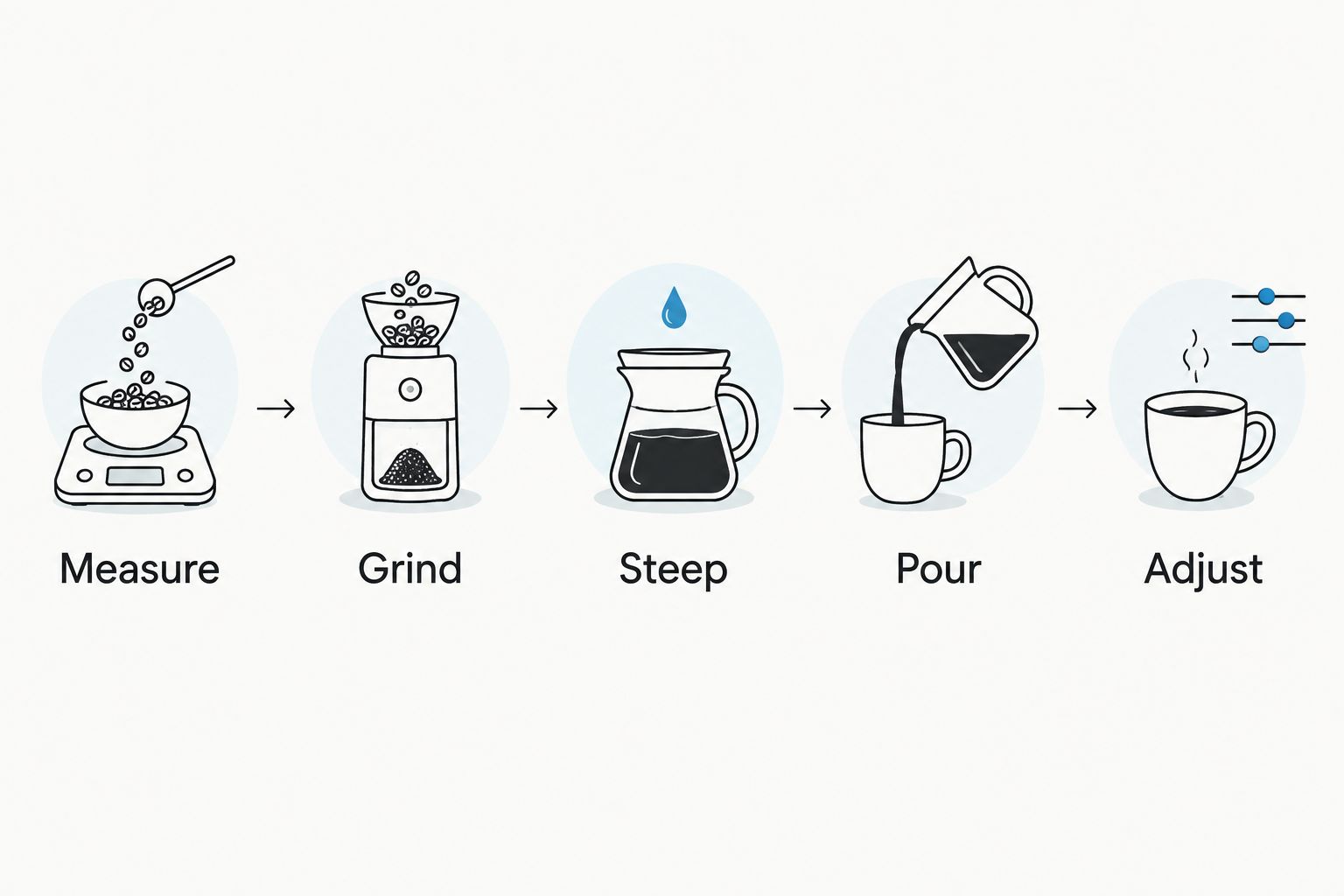
Use one repeatable recipe to compare your 2026 choices. As a starting recipe, measure 30 grams of coffee and 500 grams of water, then steep for 4 minutes. These are starting settings, not a claim that every coffee tastes best at the same ratio or time.
- Measure: Weigh the coffee and water so you can repeat the brew.
- Grind: Start coarse, with particles more like coarse salt than powder.
- Steep: Add hot water, wet the grounds evenly, and start the timer.
- Pour: Press gently and pour the finished coffee into cups or another vessel.
- Adjust: Taste after the coffee cools slightly, then change one setting next time.
If the cup tastes weak but otherwise pleasant, use more coffee in the next brew. If it tastes sharp and thin, try a slightly finer grind or longer steep. If it tastes harsh, test a slightly coarser grind or shorter steep before changing roast.
A muddy cup points you toward grind consistency and pouring technique. Press gently, avoid squeezing the grounds, and leave the last sediment-heavy portion behind. A metal filter will not make French press coffee as clear as paper-filtered coffee.
How we ranked
The 2026 ranking uses roast fit, grind control, flavor direction, and preparation effort. French Roast and French Vanilla are assessed against their supplied product descriptions; the remaining recommendations are coffee styles rather than named products.
The list does not claim a taste-test winner. Each option owns a different use case, and the limitations matter as much as the advantages. Medium-roast whole beans remain the default because they let you adjust the grind while you learn your preferred recipe.
Which French press coffee should you choose?
Choose medium-roast whole beans if you have a grinder and no firm roast preference. Choose explicitly coarse-ground medium roast if you want fewer preparation steps. Those are the everyday starting points.
Cinder and Cedar Coffee Roasters’ French Roast is best for French press drinkers who want a bold, deep-dark cup. French Vanilla serves a different preference: added vanilla flavor. Choose light-roast single-origin coffee when exploring brighter flavors matters more than finding a familiar dark cup.
For your next 2026 purchase, settle the flavor question first and the format question second. A suitable grind cannot turn a flavor you dislike into your daily favorite.
FAQ
What's the best coffee roast for a French press?
Medium roast is the starting recommendation when you do not already have a preference. Choose dark roast for a roast-forward cup or light roast for brighter flavors; French press does not require French roast.
Are whole beans better than ground coffee for French press?
Whole beans are better when you want control over the grind and have a grinder. Explicitly coarse-ground coffee is the practical choice when you want to skip grinding.
Is French Roast the same as coffee made in a French press?
No. French Roast describes a roast style, while French press describes a brewing method. The named French Roast in this guide is the African-coffee version described as deep-dark and bold.
Can I use light-roast coffee in a French press?
Yes, you can brew light-roast coffee in a French press. If the cup tastes sharp and thin, test a slightly finer grind or longer steep before deciding the beans are unsuitable.
How much coffee should I put in a French press?
Start with 30 grams of coffee for 500 grams of water. Treat that as a repeatable starting recipe and adjust the coffee amount to suit your preferred strength.
How long should French press coffee steep?
Start with a 4-minute steep for the recipe in this guide. Keep the coffee amount and water amount fixed while you test a different steep time.
Why does my French press coffee have sediment?
The metal filter allows fine coffee particles into the cup. Use a consistent coarse grind, press gently, and leave the sediment-heavy last portion in the brewer.
One last thing
Pour the finished coffee out of the French press rather than leaving the entire batch sitting with the grounds. Pressing the plunger does not remove the coffee from contact with them.
That small routine change helps you evaluate the beans more fairly. Taste the cup you brewed, not a batch that keeps changing while you finish breakfast.